Monday, 10 March 2008

Arts of Survival

Almost 40 years ago, Victor Papanek claimed "that which we throw away, we fail to value." (Papanek 1971) Having rather obsolescent consumption habits may only be natural to people living in the developed world. In the developing world however, most people have not had the 'opportunity' to be obsolescent. It is within these circumstances that one can ascertain the real material value of an object. In 'Design for the Real World' Papanek demonstrates how people from less prosperous regions of the world learn to fully exploit the materiality of an object. He came across a cooking stove design made from used license plates in Mexico, sold for 8 cents. A family usually used this stove for 10 to 15 years, before its soldering would disintegrate. Only if the broken license-plate-stove would be completely irreparable, would the family afford to buy a new stove.

The intention of this example is not to glorify the creativity of slum dwellers. To the contrary, it serves as an indication of the terrible living conditions of the majority of this world's population. Body Shop founder and human activitst Anita Roddick has stated: "(...) a short walk through the outer estates of many of the greates cities (...) betrays the hideous ugliness that we expect large groups of the world's population to live in. Often it is ugliness, that has been deliberately designed as a concrete monstrosity, using regeneration money that remains an unpaid debt long after the new batilles have crumbled away." (Simms & Smith 2008) This elloquent opinion inspires me to think that, perhaps, designers need to start designing things that are more durable, because "that which we throw away, we fail to value." (Papanek 1971)

Papanek, V. 1971. Design For The Real World. Great Britain: Paladin.
Simms, A. and Smith, J. 2008. Do Good Lives Have To Cost The Earth? London: Constable

Futures

Should design be a luxury or a necessity?

In the “Futures” lecture I picked up a quote, from Kate Stohr out of the book “Design Like you Give a Damn” (London: Thames and Hudson, 2006), page 34, which I like to discuss further.
The passage reads as follows: “This disconnect would eventually lead to a crisis of faith: What role should design play in providing basic shelter? How could architects best address the needs of the displaced and disenfranchised? And, at the heart of these questions: Should design be considered a luxury or a necessity?”
What I find the most interesting part is the question should design be a luxury or a necessity?
So is design a “fairy dust sprinkled on products”, a lifestyle we live or something much more important. Although please do not understand me wrongly, I think that fairy dust on a product is very important.
But should we not make intelligent use of design, should not that be the aim of a good designer. Should not form follow function?
I think design is not a luxury. Design is a tool, a tool to make sense of an object, make it practicable and not over-complicate it. In that sense I believe designers should approach design. Therefore do not only design for the 20 percent of the world population, which is considered as wealthy, but for the 80 percent, which live in poverty. I think, that in the future designers should aim to achieve so.
Design is not a luxury because design makes objects usable and only if it is designed it will achieve to fulfill its use in the best possible way.
The role of design in providing basic shelter is to make it practicable, cheap, useful, clever, adoptable, flexible, better and reliable. No architect can achieve so without the help of a designer.

Esse est percipi – “Design counts”.

'ASIMO' (artificial natural)


Honda has developed a humanoid robot named 'ASIMO'. The machine is created to serve its human counterpart, supported by the built-in intelligence, which enables it to multi-task for an approximate 25 minutes. At the current stage, ASIMO can read facial expressions and human body language of its human subject. That's not all this light weight (magnesium alloy) robot can muster. It has the ability to: run at 6km/h in straight or circular sets, push a cart at a set speed, going from straight to sharp bends in fluent form, the agility to carry and hold objects, that weigh around 2kg or less, climb stairs or descend from long stairwells with ease, by measuring each step without any mistakes (ideal for office assistance).

The ASIMO with all its human qualities, ranging from: greeting oncoming people, follow them, move in the direction a person indicates, recognises a face for future reference, has a built network that is connected to the internet, which provides information on demand. When totally independent, without 'assistance', ASIMO can adjust to situations, when placed in an environment, alien to office building settings. Its machine qualities are governed by precision, picking upon spatial flow, and mapping locations with high-tech cameras. When moving from A to B, it calculates the distance of location from memory, and executes with precision. 

It has taken the research team, three decades to assemble the 'original' concept. The vision could not be realized back then, due to 'slow' technological advancements. Robots are made to deliver service to humans, each model shipped to meet standards. It has opened up a market for robotic commodities. Extensive studies are carried out to formulate, how a humanoid robot can coexist amongst humans, and how it would contribute to society at large. "It's likely the robots will become the most valued commodity, in centuries to come."

http://world.honda.com/ASIMO/

CONTACTED TRIBES

With our practices we created a kinky fractal structure. With giddy and superficial pace we developed an extreme 'imperative' scope. For many years we focused on physical reality and physical world that is. We raised topics that caught people's attention which got 'them interested in some of the more remarkable aspects of the physical world and various speculative matters.' (Penrose, 1994) And, we still don't know the answer to our real motive.

We industrialized almost everything that surrounds us, that binds us. We have designed 'behind the closed window', and we have sculpted 'the giant monster' so inevitable that only a pinch of tribes remain non-contacted. It is only a matter of time when logging industry will forced them to leave their homes and left them obliged to be dependent on drugs when sick.
Our fruitless killing without depending on survival is much of our everyday life. 'All life depends on death', but not on needless counts. We create shelters and provide other humanitarian design solutions in order to redeem the problem that we created in the first place. This is neither the first nor the last 'flew over the cuckoo's nest', and we still can't put reasons on it to exculpate the accused. ARTIFICIAL.

<
Hurricane Katrina lumbered ashore in 2005 with punishing winds and torrential rain, made Florida handicap. The United States, the largest producer of greenhouse gas emissions, should bear the responsibility for the disaster.

>
'The struggle between what could be called the Uncreated and the Creation - illustrated by the permanent contradiction between man and his taboo. Everyday love and the capitalism way of life. Cannibalism. Absorption of the sacred enemy. That he may be transformed into a totem. The human adventure ...' (Andrade, 1930)

<
Cannibalism is occasionally still carried out by the Kombai people of West Papua, now Irian Jaya.

In our adventure, we would even investigate exceptional cannibalism as a homicide and shut our eyes before genocide. We are looking ahead engaging with intolerance towards cannibalism, that only appears to be a form of tribal punishment, executed by a member of the family that lost a man. And only then, when a fiend male is a killer, and that is practicing witchcraft. Male Witches are believed to be eating the souls of their victims, and their brain and the stomach, where the souls lies, must be eaten in return to free the soul and end the terror. NATURAL.

>
'... The earthly end, only the pure elites, however, where able to realise carnal cannibalism, which contains the highest meaning of life and avoids all of the catechistic evils identified by Freud. What takes place is not a sublimation of sexual instinct. It is the thermometric scale of the cannibal instinct. From carnal, it becomes elective and creates friendship. Affectionate, Love. Speculative, Science. It turns away and transfers itself. We approach vilification. Low cannibalism joined with the sins of the catechism - envy, usury, calumny, murder. It is against this plague of so-called cultured and Christian peoples that we act. Cannibalism.' (Andrade, 1930)

Even though, we are 'moral beings capable of acting from a reasoned set of rules', and these rules are defined as 'ethics', we contradict and trick ourselves - our senses lead us astray. We all are contacted by 'the giant monster'. And now, we are here to go and find other tribes that remain non-contacted, but not for long, no longer then ten years, give or take a couple.

Survival - It's up to you


The problem inherent in designing for “the other 90%” lies in the fact that this 90% does not represent 90% of a viable global market; the other 10% have most of the world’s wealth, and unfortunately money makes the world go round. To design for the Third World could sacrifice a design firm’s profitability for its reputation, and possibly put the country into even more debt (perversely, probably to the design’s country of origin) if an item sells well there.

Regardless, for a country to improve its standards of living the whole nation needs to contribute, receiving outside aid only makes the situation more bearable in the short term -

“as UN researchers emphasise, ‘there is little or no planning to accommodate these people or provide them with services.’” Mike Davis, Planet of Slums, Verso 2006.

Couple that with the difficulty of a First World firm designing for such a culturally different and diverse population, it’s an almost overwhelming proposition. Campaigning and literature has made many acknowledge the difference in quality of life in the Third World, but only an intrepid few make the tentative step towards attempting to help.

I believe it is up to the designers themselves to decide whether it is viable to design for “the other 90%”. Of course it makes moral sense to do so, however it depends on whether it is an economically viable option and not just a satisfying deed. After all, everyone in a First World country needs to earn an income to survive, themselves.

Image from : http://www.marxist.com/Globalisation/third_world_debt.htm

The Arts of Survival- Survival by Design?

So many times we hear of survival of the fittest and all that goes along with Darwinism, but what truth is there behind this, for the past centuries of human existence? Yes, evolution has played a major role in the sustaining vitality of the human race, but what about now? Have we reached the end of our evolutionary cycles? Do we no longer need to adapt to our surroundings with our ever expanding need to design our personal means of survival?

We are the only species to really change our environment to better suit our needs rather than us change to fit our surroundings. This seems to be our approach to many things. Instead of finding a means of compromise and letting ourselves naturally adapt we immediately come up with some way to change our surroundings so we do not need to do the changing. An extreme example of this is living in a semi toxic environment where breathing and sustainability would be quite hard. We come up with shelters, gas masks, air purifiers etc. All products of design to help us maintain healthy living environments. Clearly, it would be hazardous to continue living through these circumstances but there is no way for us to naturally adapt or evolve to be able to survive these situations. We are not exposed to small doses with enough time for our bodies to naturally change and sustain. Organisms breathing oxygen for the first time, a once toxic environment, evolution and adaptation had to occur along the way on some level or the transition from water to land would have never occurred. How much of a natural adaptation process has the human race accomplished most recently?

It appears that we no longer have the need to change ourselves. We implement design to help change our surroundings to better suit our needs rather than any other sort of personal developments we could make naturally. Without design it is hard to say if the human race would even continue to be in existence. Without design we certainly would be in a different sort of evolutionary state. Design is essential to our immediate survival, but at the same time the question stands, is design hindering our evolutionary advancements?


Arts of survival

Investment, Design and Education in rural Places to stop poverty and migration into cities.

  • "In 1950 there were 86 cities in the world with a population over one million; today there are 400, and by 2015, there will be at least 550.1.

  • Cities, indeed, have absorbed nearly two-thirds of the globalpopulation explosion since 1950 and are currently growing by a million babies and migrants each week.

  • 1.2 billion people are living on less than a dollar a day.

  • There may be more than quarter of a million slums on earth and in 2001 it wasestimated that there were at least 921 million slum-dwellers." (Mike Davis, Planet of Slums)

What can be done to stop poor people from migrating into cities and in many cases into a bigger dilemma?

Banking on the poor and "friends of rural Women"

In the late 70s in Bangladesh, Muhammed Yunus (Nobel Peace Price Winner) and the Grameem Bank started as the first to give out micro-credits to poor rural women. Mainly Women are chosen as they are more likely than men in repaying loans and divide their earnings over the whole family.
The idea is that small loans with low interest can make a big difference in poor peoples lifes.
Micro credits in rural Communities give opportunities to many people that otherwise would have left to cities; It has been observed that the villages receiveing micro-fundings have not only less emigration but as well a lot of people returning from the cities.

Yanus believes that this system can make an end to poverty in the whole world. At July 2007 Grameen Bank has issued US$ 6.38 billion to 7.4 million borrowers and by the time hundreds of other micro-financing Institutions have rosen.
http://www.youtube.com/watch?v=WfdD3NPgEY4&feature=related
http://www.youtube.com/watch?v=MrUQKuvsmvw&feature=related

Not only financially can be helped; Education and Design concepts can help in poor community's as well as money.
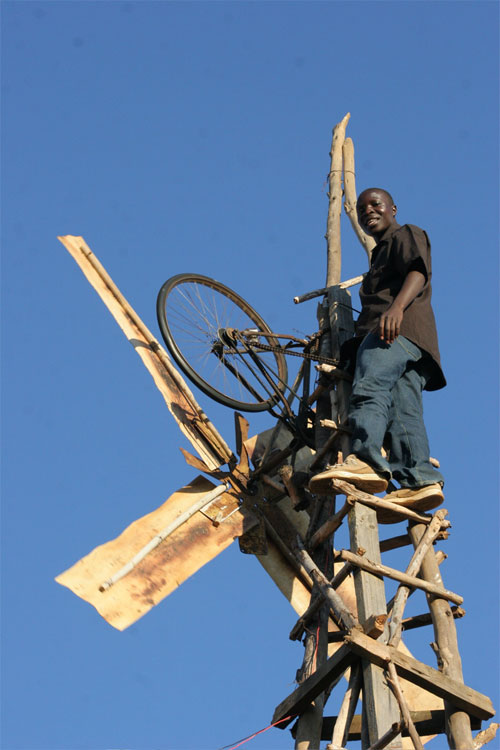
With 14 Years William Kamkwamba from Malawi, has build a windmill out of scrap after having seen a picture in the book called "Using Energy" in a library close to his village.
The Windmill powers three pulbs and 2 radios. William is now 19 and looks for funding for his big dream of going back to school and building a bigger windmill that provides power for the whole community.
http://www.ted.com/index.php/talks/view/id/153

Opportunity is something that millions of poor people are fighting for; they illegally cross boarders, risk their lives and then find themselves in an other miserable slum of an other overpopulated and polluted city, dreaming of their villages and families they have left behind.
In order to stop this vicious circle we should start at the very bottom and invest and design for the rural people.

Virtual identity (futures)


Design has its value, to broaden man's vision for the future, even if the future can't be realized in the realm of  'existing space'. A 'New world' had been created from the literary movement, inspired by Neal Stephensons novel 'Snow Crash'. It was to be known as Linden labs, the directors of
Second life, virtual worlds.


Second life's popularity gained '9.8 million' registered accounts in 5 years, prior to its launch in 2003. The residents could represent themselves in a wide variety of humanoid or other forms, taking physical and customizing them to a change in appearance, either as male or female avatars. The freedom of wandering around, talking to other avatars, building homes, visiting clubs and spending linden dollars on virtual commodity, seems life deserves another usage, in the from of  'virtual identity'. Since the environment is expanding and more people are adopting to the idea of living a virtual life, satisfied by the need to be accepted in a world excluding 'traditional values' and 'religion'. A world without physical engagement and only 'information' dominates future development. Where does such a world and information reside? 'It is home to the Internet, and everything it holds in its domain.'

http://www.secondlife.com

Sunday, 9 March 2008

The Arts of Survival - What constitutes a living?

If we consider consumption as we consider a food chain, we may understand that products we recycle everyday and consider in ‘old’ terms “near the end of their life-span” and in ‘new’ terms “at changing point in their lifecycle” may be understood very different to people living and working in the heart of slums across the world.

Trying to understand arts of survival Dhavari a central slum-city of Mumbai is a good place to take a closer look. An Indian (but American trained) architect Mukesh Mehta, has accomplished to get the official stamp to carry out his urban plan for this slum area. The ‘problem’ being that Dhavari has grown for over 3 generations and Mumbai has now expanded so far out that it is surrounding the slum, making Dhavari the physical city-center. It is clear that the response to the plan within Dhavari is varied and mainly negative. A debate site www.dhavari.org expresses a few opinions.

We may try to solve the problems with the best intentions and sometimes with necessity but how do we consider the soul of the lives of people we intend to help in the process.

A big issue is that the main industry of Dhavari, as in so many other slum cities, are recycling-factories and pottery, both very polluting. In the case of Dhavari both types of industry is no longer feasible to have in the center of as large a city as Mumbai, the smoke from the potteries are so bad that it affects nearby hospitals. Any polluting industries are banned in the new plan. These industries will have to move outside the city. Having found a way to make something new from scrap and build a house and a life from not much, the concern of the ‘slum-dwellers’ is logical. It doesn’t take much imagination to think that if this ‘urbanization’ is carried out merely with good intentions but without great caution, it could end up forcing the inhabitants of Dhavari to the new edge of Mumbai to start all over again.


Tate Modern ‘Global Cities’ Exhibition Folder

http://www.economist.com/world/asia/displaystory.cfm?story_id=10311257

Image from above Economist article

http://ngm.nationalgeographic.com/ngm/0705/feature3/index.html?fs=seabed.nationalgeographic.com

http://www.dharavi.org/


Is it natural to surround ourselves in the natural?

My last blog showed how Heather Barnett used biological imagery to form repeat patterns for use on wallpaper. The use of microbiological imagery was interesting as it was unique, but it made me realise the extent to which natural imagery surrounds us; we have plants in our homes, and we give flowers as gestures of affection. We are surrounded by floral patterned textiles and wallpapers, and wood grain exposed in our floors and furniture. Flicking through this month’s Elle decoration demonstrates that being surrounded by the ‘natural’ seems natural.


My Bed - Now thats 'Natural'!


We are encouraged to eat naturally, to sleep naturally, and to encourage natural light into our living and working spaces. We are now being sold energy packages as ‘green’. It seems the ‘laws’ of nature play a bigger part in our lives than we realise. ‘Going Green’ is clearly a currently sexy issue, so to what extent is this natural? And to what extent is the ‘natural’ a cultural construct? Or nature’s dictatorship?


In Future Natural George Robertson et al. discuss the term Futurenatural.
“The construction and reproduction of ‘nature’, the ways that this ‘nature’ is then instrumental in defining what is or is not natural, and how formulations of ‘what is natural’ eventually attain the status of convention that present ‘nature’ and ‘the natural’ as seemingly unproblematic.” (1:1996)
Robertson et al. suggest nature is a cultural construct formed over years and years of human intervention into our environment. Suggesting our ideas of ‘nature’ are highly constructed and manipulated.
“’nature’ is like all concepts, a product of discourse” (1:1996)

Ester Kneen

Robertson, G et al. (1996) Future Natural. London: Routledge
Elle Decoration. March 2008

Friday, 7 March 2008

The Arts of Survival : Clean drinking water


In our community, we often take clean drinking water for granted. As we turn on the tap, clean water flows out continuously and we can have much as we want. Human beings theoretically cannot survive more then 3 days without water. It is a living essential and one of the most basic needs. Living in a developed country, we have absolutely no problem with fulfilling these basic needs. However, some desert regions in the world such as Rajasthan, access to safe drinking water is difficult.
Rajasthan is a developing state in India. As there is very limited Government funding and rainwater provides inadequate amounts of water so subsequently, they struggle to survive without this human necessity.


The Acumenfund organization used a system called Water Pyramid patented by Aqua-Aero Water System (AAWS) to solve the shortage of safe water in Rajasthan. The Water Pyramid was designed to evaporate polluted water and through condensation, collecting distilled water. The Acumenfund organization claimed, “Each Water Pyramid produces enough to meet the needs of 500 individuals on a daily basis.” As the initial cost of this technology is very low, this means many developing countries will benefit from this design.
The AAWS is a private company which designs sustainable solutions for water problems around the world. Design exists to ease living in general. Why didn’t more designers commit to sustaining this basic human need and let every human being in the world live up to the basic standard of living. As designers, what would be more meaningful than to save lives by using your design?

http://www.acumenfund.org/investment/aqua-aero-water-systems.html
http://www.survivalwater.info/
http://www.aaws.nl/home.htm

Wednesday, 5 March 2008

about Spiekermann

Eric Spiekermann is one of the most well-known typographers of our time. He designed typefaces such as Meta, Officina FF Info, created corporate identities for the german government, VW and Audi and founded Meta Design, Fontshop and United Designers, now SpiekermannPartners.

What kind of rol
e do ethics & sustainibility play in this very specific field of design? How does Spiekermann define his philosophy towards his work?
I put together some interviews and his profil on SpiekerBlog, which is a always worth a visit.

When it comes to the design of typefaces, Spiekermann sees himself as more of a problem solver than an artist as "a designer visualizes a client's issues, problems, brief. An artist his own. Designers and artists use artistic means to show their concepts and designers also use intuition. Thus the confusion. But if i wanted to work like an artist, i would have become an artist and not a designer. I also use science more than an artist would."
"If a design project, however, is to be considered successful – and that would be the true measure of quality – it will not only solve the problem at hand, but also add an aesthetic dimension beyond the pragmatic issues."


What makes a good typeface?


> What makes a good typeface is decided by the users, not the designer.
> Most good typefaces have been designed for one purpose, they do not come from a designer’s whim.

Bodoni designed all his faces for specific books, Times was designed for the newspaper, Frutiger for signage at Charles de Gaulle airport, Helvetica to appeal to certain graphic designers, Bell Gothic for the American telephone books, Gill for a shopfront, Century for a magazine, Meta for the German post office.

> There are certain laws of perception as well as cultural traditions which a typeface has to adhere to.
> It has to look almost like all the others, but...

> just be a little different

His process for beginning a new typeface is simple and straightforward. “Identify a problem – like space saving, bad paper, low resolution, on-screen use – then find typefaces that almost work but could be improved,” he explains. “Study them. Note the approaches and failings. Sleep on it, then start sketching without looking at anything else.”

Although Spiekermann has quite high values concerning a practical and sustainible use of his designs on their own, he has never refused to work on projects for clients that produce polluting and in a way superflous „products“ as the automotive or the aeronautic industry.

Futures


In the post-apocalyptic novel “Do Androids Dream of Electric Sheep” Philip K Dick suggested a bleak future, layer upon layer of toxic dust covers the earth, and those that can afford it programme a machine daily to provide them with a cocktail of drugs, so they find it easier can tolerate their lives. Consumerism, and how a person’s possessions are perceived to relate to their worth, is also dealt with in the book. Each person still living on earth is expected by society to own an animal of some kind, it is seen as humanity’s duty to preserve a small part of the natural world, which has long since disintegrated. If they cannot afford an animal, they will own a robot, with the aim of fooling their neighbours into thinking they own an animal, so vital is this ownership to their contribution to society. The rarity of the animal determines how wealthy, or well connected the owner is, and therefore affects everything, from the individual’s sense of self-worth, to his standing in the community, leaving people depressed and apathetic towards their lives. The animal is of course an allegory for products and capital owned by people in the West today. It is a very real fear that a similar situation to this may actually come about, in terms of the consumerism industry. Westerners are already encouraged to consume as much as possible, the bourgeoisie in particular, are encouraged to place far too much importance on looks and possessions, this culture seems set to develop and grow dramatically in the future, because, of course, it is essential for the economy for this to happen. The future of design is in danger of becoming completely saturated with one-step-better products, people will compare and judge others solely on the speed and calibre of their car or phone, as they do in “Do Androids…” Many factors are to blame, but the design industry, in particular advertising, has a lot to answer for. We must be sure that the future of design does not continue to encourage this culture.

Artificial Natural


There is a belief among human beings that we are above or separate from nature due to our advances in scientific research and knowledge. Because of this we seem to lack the ability to interact with the ‘artificial natural’ in the same way as we do for ‘real’ natural beings and environments.

Artist Eduardo Kac, the creator of the “GFP Bunny” Alba, has approached this issue with his transgenic artwork, which Kac says is ‘a new art form based on the use of genetic engineering to transfer natural or synthetic genes to an organism, to create unique living beings. This must be done with great care, with acknowledgment of the complex issues thus raised and, above all, with a commitment to respect, nurture, and love the life thus created.’1 The appearance of Alba in the media caused a public dialogue about her social integration. Similar to the worlds attachment to Dolly, the first cloned sheep, Alba is a very special and unique animal looked after by the artist and his family, ‘she immediately awoke in me a strong and urgent sense of responsibility for her well-being.’1 Kac is questioning and trying to define ‘interspecies communication between humans and a transgenic mammal’1. Alba is at the centre of Kac’s campaign to create ‘public respect and appreciation for the emotional and cognitive life of transgenic animals’.

Kac has used media attention skillfully to communicate his message as an art project and social experiment; where as the famous scientific breakthrough of the ‘mouse with the human ear’ is not an art project, a purely scientific advance that was reported in a harsher light. In 1999, ‘the anti-genetics group, Turning Point Project, placed a full-page ad in the New York Times showing the photo of the mouse with the human ear, with a misleading caption that read, "This is an actual photo of a genetically engineered mouse with a human ear on its back". In truth, the mouse was not genetically engineered, and the "ear" had no human cells in it.’2 These examples show how design aids the representation of scientific advances; a designer would approach this issue more holistically, showing the public the science and social ethics.

1 http://www.ekac.org/gfpbunny.html

2 http://www.abc.net.au/science/k2/moments/s1644154.htm

Image: http://www.ekac.org/gfpbunny.html

Floating Imagery

The virtual world is an ever-expanding fascination. Take for example the usage of Second Life the ability for the user to freely express himself/herself in a totally complete virtual world. Whether this involves socialising, purchasing goods or build new communities this 3D cyber space allows the user to interact with other registered people without actually knowing them.

‘For a long time 3D movies and TV shows have been a bit of a gimmick. They have been used to re-energise a tired franchise, help a film stand out at a crowded box office or to give TV viewers a glimpse of what the future might hold.’ BBC News

This use of ‘mid-air effect’ interaction has always been a very well developed way of communicating what you see on a screen to actually physical form. The IMAX cinema has been an ever-growing, successful and alternative form of visual communication. The recent development of this communication has been expression in most modern sci-fi films. For example the computer interface in the film Minority Report, and the way Jedi’s visually communicate in Star Wars.


Physical interaction is ultimately the next step f
orward especially with the growing obesity rate and the future risk of obesity and heart disease especially among children. The Nintendo Wii and other digital formats have caught this market by producing sensitive remote controls that interact with the users movements to produce an almost identical reaction with the characters on-screen.
The way 3D imagery has developed and evolved, the future idea of having a virtual pet or Tamagotchi would not consist of being only on a screen but an actual floating virtual simulation. This could then be developed for educational practices such as teaching or watching intricate surgical operations. Getting up close and personal with wildlife programmes or understanding sea creatures without actually leaving the ‘armchair’. The ability to reminisce in pre-recorded memories such as weddings and birthday parties on a normal analogue TV screen.

Tuesday, 4 March 2008

Energy forecast


With rising sea levels washing away inhabited islands such as Lohachara, (once home to 10,000 people) has driven major costal communities inland. The risk is faced with flooding and strong winds destroying homes and agriculture.

The world is in need of a new energy source to compensate for industrialised global warming. In the light of climate change, the world urgently needs to acquire different energy resources with the ability to deliver 'cleaner renewable energy'. One notable company has the potential to make a 'major' contribution to the future energy needs.

Marine current turbines (MCT), is the world leader in the development of new technology for exploring tidal currents for large-scale power generators. The turbines run with tides of renewable energy, producing no pollution and delivering to a predictable timetable. Marine turbines work, in similarity to submerged windmills, but are driven by flowing water rather than air. They are mainly installed in the sea at locations with high tidal currents. The water currents have a major advantage of being an energy resource, which is mostly 'predictable' as tides that cause them. It is more reliable than wind or wave energy that appear randomly based on the weather system. The technology consists of twin axial flow rotors of 15m to 20m in diameter, each driving a generator via a gearbox similar to a hydroelectric turbine or wind turbine. the twin power units are set into a hole drilled into the seabed. The submerged turbine, depending on the local flow pattern and peak velocity, will be grouped in arrays of wind farms under the sea. The same way wind turbines in a wind farm are set out in rows to catch the wind.

'Environmentalists have been notified that the new technology does not offer any serious threat to fish or marine mammals'. The rotor turns slowly in its place, compared to a ships propeller, typically runs 10 times as fast and moving continuously.

"Since the world is water based, why not harness energy from this big pool?"

Our societies have a deep relationship with the notion of artificial natural. There are many examples showing how the human uses this notion and how the users are believing these fake truths. One of the main areas which is implemented into our societies and which is linked to this subject is cinema. People all around the world learn how to simulate and recreate feelings and actions in the most natural way possible: they are called actors. The ones that are talented will then often be recognised for their skills. People like you and me worship some of these comedians. And we respect them for fooling us each time we watch one of their performances. Things look really natural but a lot of effort is actually made to make moments "feel" natural. But technicians actually designed a whole process to seduce the viewer and his mind to let him fall into a confusion between real and unreal worlds.


Another example of our tolerance towards the artificial natural can be found in the concept of the Zoo. In this case artificial habitats are being created for the animals. But this might be a way to fool the human instead of the animal. The animal certainly understands that he is not in his natural habitat and would probably prefer to live in its original environment. However the human gets the illusion of the natural habitat being a faithful replica of nature and its freedom.


But in both cases this method is used to bring something positive to the user such as education and knowlege. However to reach this level of intelligence we are obliged to take the path of naïvety towards what we see and feel. We often go over this lack of realism because we want to simply enjoy a moment of entertainment. And entertainment is based on telling people stories but realism can make stories more effective. This is when the intervention of an artificial natural process is needed.
Nature, New and Improved:
In Stores 2032

In his book “Travels in Hyperreality”, Umberto Eco explores America’s cultural shortcomings, and how we as a society always strive to fabricate emulations of life in an effort to create something that is better than what reality can offer us.

Through Disneyworld, Eco finds the perfect example of hyperreality, where everything is fashioned to be brighter, more colourful and entertaining than every day life. In this civilisation, there is no war or risk; there is only fun, sweet food and adventure. Every facet of this world is artificial, from the plastic trees, to the animatronics that impersonate the wild. Nothing is left to nature, or to chance, everything is strictly controlled monitored and planned. When leaving “you risk feeling homesick for Disneyland” and miss the safe yet stimulating environment “where the wild animals don’t have to be coaxed. Disneyland tells us that technology can give us more reality that nature can”.


Imagine an apple you can grow at a touch of a button, a dog that will obey every command, grass that changes colour to your mood and weather that is not just predictable, but controllable.

So when the technology becomes available for us to replace nature, having all the benefits with none of the drawbacks, what will stop us from doing so? If humanity is so fond of these farcical impersonations, why would we settle for real when we can have something that is more than real? The fight against genetically modified foods shows us that humanity is not ready to let go and that we are still prepared to contest for what was here before us but perhaps it is just a matter of time before our sentimentality wanes and we leave our roots behind.


Umberto, E. (1987) Travels in Hyperreality, Harvest Books

Climbing Walls with Carbon Nanotubes


The human being has always tried to go beyond their possibilities, they don’t have wings to fly, don’t have gills to dive and also they don’t have claws to climb.
But sometimes just observing the nature, humans have achieved lots of great discoveries and inventions, from the design of a plane or helicopter and the principles of aerodynamics based in the observation of birds and insects, until the creation of the submarines to explore the secrets of the ocean through the observation of compression and decompression systems in the sperm whales.
Now is almost ready and under further research a new material inspired in the microscopic hairs that the gecko lizard possess in their feet, which will be able to allow the humans to access to some activities that didn’t have before and to improve enormously some existent ones.
The prospect of being able to emulate a gecko and walk up a wall and across the ceiling has come a step closer to reality. Researchers at the University of Akron and Rensselaer Polytechnic Institute (RPI) have begun to work out how to make a material coated with synthetic gecko hairs. This new material (developed by engineers mimicking the hairs on gecko feet by growing carbon nanotubes in bundles), has been created to match the nimble lizard's incredible grip, and researchers say that the applications will be endless.
We could make super-grip shoes for athletes and tyres that hold the road better in all weathers, for example. And in Hollywood, actors playing superheroes like Spiderman or Neo from The Matrix could climb walls and walk on the ceiling without the studios resorting to computer graphics.
The ability of some animal species to develop tools to survive in their eco-systems and that have needed thousands of years to improve and perform, now can be emulated by humans using their technologies to make more efficient the way they live, just through some years of investigation and testing.

Pablo Milara

http://www.newscientist.com/article.ns?id=dn3726

http://www.technologyreview.com/Nanotech/18966/

Artificial Natural: Untouchable- more natural, more creepy


There are some ways “to be natural” by technology. Humanoid-robots or CG is approaching to “the natural” from 100% artificial, a combination of metals or a drawing in computers, while biotechnology is starting from altering and manipulating existing nature. Which approach can be comfortable for people’s mentality? What kinds of “fear” are there in approach to the “untouchable” nature? There are difficulties of ethics in artificial natural.,

The “uncanny valley” is the term used by robotics-scientists or computer graphic designers to describe “the unnerving feeling that occurs when something looks and acts much like a human, but quite clearly isn't” [1]. Even though people know it is artificial, they unconsciously recognise quite human like robots or CG as a real human. However, at the same time, they can perceive a little unnaturalness, which makes the “uncanny” feeling. As examples, recent humanoid robots or ‘Gollum’ in the film ‘The Lord of the Ring’ and intended-unnatural character of ‘Mr. Incredible’ are usually mentioned. To recreate human being is a kind of untouchable fields for human, even though they do not have “life” and outside of the problems about human-rights.

http://www.newscientist.com/blog/technology/2007/10/technology-to-creep-you-out.html

http://www.youtube.com/watch?v=lCPgJ39-oUI&NR=1

In ‘The Politics of The Artificial”, idea of “simulacra” or “Goddess” is used for considering the division of nature and human [2]. I, from eastern country, actually feel uncanny from the video above but sometimes I hear that western countries have more mental resistance for humanoid robot rather than biotechnology while eastern countries are opposite of them because of the cultural difference from religions. It is a non academic myth but at least we should remark there are some levels of ethics from global common to local common.

The ethics for artificial natural is an unclear field and tends to be more subjective because it more relies on people’s psychological matters rather than physical problems such as environmental disruptions. How can we draw the border line between “touchable” and “untouchable” in the nature by various senses of ethics and will it be interruption for our further positive/negative development for “Spaceship Earth”?

[1] ”Technology to creep you out” <
http://www.newscientist.com/blog/technology/2007/10/technology-to-creep-you-out.html> (accessed on 05 March 2008)
[2] Margolin, Victor. The Politics of the Artificial p.107-120. (London: University of Chicago Press, Ltd., 2002)
“The Uncanny Valley”
<
http://www.arclight.net/~pdb/nonfiction/uncanny-valley.html> (accessed on 05 March 2008)

Image: <http://www.engadget.com/2007/06/06/kansei-makes-a-comeback-with-reactive-facial-expressions/>

Designing Panic Buttons

Immediately after the events of September 11th news reports told us that gas-masks were selling out all over the place. (1)
You'd have thought people would have calmed down a bit by now, but apparently not..

I found a company called 'City Survive', (2) whose website offers a variety of products for eventualities such as a bird-flu outbreak or biological terror attack, and noticed immediately that almost all the products were apparently SOLD OUT! I laughed to myself. Is this real or just a marketing ploy to make vulnerable people feel even more worried?

The website even features a feed of the latest terrorism news, so you can keep up to date with when you might next need to use your shiny new gas mask...

How would owning a gas mask make someone feel? Is what is being sold here merely a sense
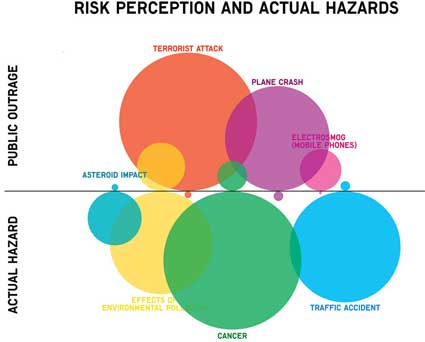
of reassurance or a real means of protection? Presumably these masks do what they claim, but as this diagram shows, the real risk of such an eventuality actually happening is small compared to the real risks that we seem less concerned about:


(3)

The way these items are sold is not necessarily ethical. It is in the best interest of the
companies marketing them have to create a sense of risk or hype up and intensify existing risk.
Are they doing an honest service that provides reassurance? Perhaps not when undeniably money is being made from people's fear.

Excerpt from 'City Survive' website:

"It is accepted by most that London is high on a list of potential terror targets.
The next attack could come in the form of more bombs bringing with them the potential for fire and the dangerous gases in smoke, or a more sophisticated attack involving chemical or biological agents.
City Survive's response to these threats is to bring you a range of compact, lightweight, easy to
carry gas masks and respirators, and our innovative City Survival Kit™, each designed to give you the best possible chance of surviving a specific terror driven scenario."


If something disasterous really did happen, having a TM on your survival kit isn't going to make it any more effective.

The rather scary look of this mask, the 'Potomac Emergency Escape Mask' (pictured) is clearly unnecessary - it doesn't need to be yellow for a start, but perhaps if it was presented with a minimal, purely functional exterior it would offer less protection psychologically? The name is also over-dramatic. Up to now we've got along fine just calling them gas-masks.

When it comes to thinking about potential impending disaster the inevitable conclusion is that the existence of however many survival contraptions cannot prevent something actually happening. If owning one helps a person sleep better at night, I guess that's fine. But lets not get too worked up.

I found an interesting example of how the design world (obviously I'm making a distinction between commercial product design (the gas-masks) and non-commercial design/art) has reacted to risk culture.
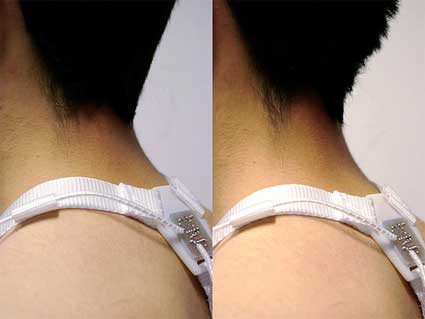
Susanna Hertrich's work at the Design Interactions department, RCA, focuses on enhancing human perception of and reaction to risk. Her piece, Alertness Enhancing Device stimulates goosebumps and makes neck-hair stand up, making the user more alert and ready for real danger. (3)


Pretty cool.

1.http://www.guardian.co.uk/uk/2001/sep/26/afghanistan.september111

2.http://www.citysurvive.com/anti_terror_gas_masks.htm#survival_kit
3.http://www.we-make-money-not-art.com/archives/2008/02/alertness-enhancing-device.php

Monday, 3 March 2008

MR. SMISH & MADAME BUTTLY RAZOR WIRE

In the following part id like to come back once more to the different roles of the designer and the artist and how they sometimes should be distinguished more clearly especially when design pieces are exhibited.
MR. SMISH & MADAME BUTTLY RAZOR WIRE is a wire fence with butterfly-shaped razors. It has been part of the MOMAs 2004 "SAFE – design takes on a risk" exhibition. To underline his critical statement about rich and poor designer Matthias Aron Megyeri presents his exhibition piece as a buyable product of mass production on his website www.sweetdreamssecurity.com. The reason why it fails as a product is because it doesn’t go to the ground of the problem. It fulfils the need to mask the growing amount of security products in our environment but it refuses to take on the real problem, which is the growing gap between the rich and the poor. The ironic nature of his statement can be already detected in his profile where he is described as a designer, „who chooses to use his products as vehicles to explore societal issues, following a critical approach closer to journalism than conventional product design.“ I’d like to contrast this piece of design with a quote of Volker Albus at „Zeitzonen 2006“ in Vienna at the University of Applied Sciences“: „Art says no, Design says no, but...“. As one of the duties of art is to question the authorities, irony is an adequate instrument to point out grievances. But design should always give an answer to a problem rather than just highlighting it. The butterfly doesn’t propose any solution to the problem. And as a product is always designed for a user it should convey a positive attitude rather than an ironic one. Sure exhibition pieces have got a right to exist but sometimes it should be questioned whether it would be possible to produce a working product as well.

–––––––––––––––––––––––––––––––––––––––––––––––––––––––––––––––
www.sweetdreamssecurity.com

design for survival

Design for Survival

With the number of ‘slums’ in developing and Third World countries rising to an astonishing amount, there has been focus on tackling the source and coming up with solutions.

In ‘Planet of Slums’, Mike Davis has a world wide political approach to the mater and presents a lot of well supported data as if to raise more awareness of the problem. He seems to make the problem a global one and ultimately asks questions of governments and political influences of the past and present. However, it’s somewhat obvious that the UN and world leading countries have a vast impact on the increase or decrease in urbanization and slums through their advances to problem solving and help strategies.

On the whole, Davis’ report is one that is most helpful when you don’t know what slums are and how they came about.

Meanwhile, some contemporary design takes the basic needs for survival for granted and focuses on making other aspect of modern life better or more efficient. This is the point that organisations like ‘design for the other 90%’ are raising through their campaigns and actions in developing and third world countries. Within their ideology they’ve split survival into six sections, Shelter, Health, Education, Water, Energy and Transport. Each one has a clear aim and attempts to achieve it in the most simplest and cost efficient way through projects supported by bigger product developing companies. Most of these projects seem quiet far fetched and sometimes miss the point like the ‘One Laptop per Child’ campaign, which ignores the use of scaffolding in an educational environment that is far behind compared to ones in the developed world.

As products, items like the portable light bag seem to be very sustainable but when you look at these campaigns as a whole the ones that work best are those that take a sustainable approach to the society they’re introduced to. Amongst other things design has the power to create culture whereby, instead of building shelter for the homeless people, you teach those people how to gather equipment and build houses independently. KickStart, a construction firm that work with other organisations to prevent poverty in Third World countries, make design solutions like the ‘latrine cover slabs’ for more affordable sanitation. The process is designed by KickSart and uses some of their products but it’s introduced in such a way that locals have overstepped the first hurdle of cost effective production and can sustain their development autonomously.

http://other90.cooperhewitt.org/

http://kickstart.org/home/

http://www.inhabitat.com/

http://bldgblog.blogspot.com/2006/05/interview-with-mike-davis-part-1.html

Artificial Natural "Give It Back"


Give It Back 
Artificial/ Natural

It is a struggle to categorise things or events into natural or artificial. One of the reasons that it is such a struggle is that it is, in itself, an artificial question. For tens of thousands of years our continual interactions with ecosystems have shaped human experience to the extent that we are no longer able to easily distinguish between what is natural and what is unnatural (artificial). The relevant question is not “artificial or natural”, but what is “of man” and what is “of nature”.

For example, when people look at a pleasant pastoral scene of honest labourers working in a field to bring in the harvest, they may think “how natural”, when in fact the opposite is true. Agriculture (probably the human activity we deem most natural) has almost completely wiped out the millions of hectares of broad oak forest that covered Europe. This isn’t a scene of natural harmony any more than the rotten cooling towers of Drax power station (singularly our largest emitter of carbon dioxide).
They are both distinctly “of man” and not “of nature” no matter how much more “natural” one scene may appear and how much more “artificial” the other appears.
Why is this distinction worthwhile pointing out?
It is a critical distinction because many people think that a return to some idyllic pre-industrial setting will save the human race from the trauma of global warming, but while this idea may be romantic, it may also be deluded.
Industry and urbanisation (“artificial” and evil) are usually singled out as the great contributors to the impending problems of the planet. While this is true, the greater truth is that agriculture (so called “natural” and good) is equally a significant threat to the planet. We imagine that factories, roads and houses blight the U.K. when agriculture in fact covers 70% of the country compared with only 14% for urban and suburban areas. That coverage leaves very little room for forest and woodland (12%)to act as either carbon sink or wildlife habitat.
We urgently need to return both urban and rural land to managed wilderness to help absorb carbon dioxide from the atmosphere and to reduce the pressure on habitat that threatens wildlife everywhere. This means that we must live more densely (urban as opposed to suburban) and that agriculture needs to be more efficient (more food per hectare) and more effective (more crops for people and less feed for livestock) so that we can start the long overdue process of giving back land to nature for reforestation and the reintroduction of threatened species.
Most of all we need to think clearly about the changes needed to improve this planet and not fall for emotive and arbitrary distinctions between what is artificial and what is natural, as it hasn’t been a relevant question for some time.
Humankind stepped beyond natural thousands of years ago.

http://www.telegraph.co.uk/earth/graphics/2007/11/14/eapower114.jpg
www.hayinart.com/2004_10.html
Statistics from D.E.F.R.A.


Supplement to the post below

'if it is our basic human nature to annex, exploit, and incorporate nonbiological stuff deep into our mental profiles - then the question is not whether we go that route, but in what ways we actively sculpt and shape it. By seeing ourselves as we truly are, we increase the chances that our future biotechnological unions will be good ones.'(Clark, 2003)

Artificial or natural?

People, have always liked to categorize things. Good and bad, moral and immoral, artificial and natural.

You may think that artificial and natural have a more clear distinction then something as subjective as morality and you may be right. However the beginning of the industrial revolution seems to have initiated the time when people first stepped way past their limitations. Mass production was invented and instantaneously one person could do the work of fifty.

One person doing the work of fifty, with the aid of a machine, or is it a machineperson doing the work of fifty people. We have cyborgized ourselves, adding to our ability’s. The question is, has this made us artificial? Or are we ourselves still natural but the technologies we use artificial, even if those technologies are placed within us?


(http://static.howstuffworks.com/gif/artificial-heart-abiocor-hand.jpg)

This is clearly debatable, surly though changing the very essence of what makes up an organism, its genes, is not debatable. You create a hybrid and this hybrid can only be called artificial or at the very least ‘man-made.’

However the insertion of new genes to produce wanted traits in an animal or crop is not a new idea. For century’s farmers have chosen the strongest, fittest, fattest of their live stock to breed in order for the next generation to be stronger, fitter, fatter. A form of controlled evolution if you will.

Even farms themselves haven’t always been around, the fact that farms are there at all has changed the landscape and habitat of the area, it has changed behaviors of animals, even pushed some animals to the brink of extinction and yet we have been almost re-programmed to consider this natural. Could extinction ever be considered natural?

As the modern world progresses we have gotten more and more ambitious with our ‘projects,’ now there is even talk of pharms where you could literally farm pharmaceuticals. Now even tobacco, the hailed bad guy of the crops could be responsible for saving about 10 million people from contracting HIV in Africa. Ironic, insane, irresponsible, incredible, ingenious. Are among the many things I could say about this project.