Wednesday, 5 March 2008

Floating Imagery

The virtual world is an ever-expanding fascination. Take for example the usage of Second Life the ability for the user to freely express himself/herself in a totally complete virtual world. Whether this involves socialising, purchasing goods or build new communities this 3D cyber space allows the user to interact with other registered people without actually knowing them.

‘For a long time 3D movies and TV shows have been a bit of a gimmick. They have been used to re-energise a tired franchise, help a film stand out at a crowded box office or to give TV viewers a glimpse of what the future might hold.’ BBC News

This use of ‘mid-air effect’ interaction has always been a very well developed way of communicating what you see on a screen to actually physical form. The IMAX cinema has been an ever-growing, successful and alternative form of visual communication. The recent development of this communication has been expression in most modern sci-fi films. For example the computer interface in the film Minority Report, and the way Jedi’s visually communicate in Star Wars.


Physical interaction is ultimately the next step f
orward especially with the growing obesity rate and the future risk of obesity and heart disease especially among children. The Nintendo Wii and other digital formats have caught this market by producing sensitive remote controls that interact with the users movements to produce an almost identical reaction with the characters on-screen.
The way 3D imagery has developed and evolved, the future idea of having a virtual pet or Tamagotchi would not consist of being only on a screen but an actual floating virtual simulation. This could then be developed for educational practices such as teaching or watching intricate surgical operations. Getting up close and personal with wildlife programmes or understanding sea creatures without actually leaving the ‘armchair’. The ability to reminisce in pre-recorded memories such as weddings and birthday parties on a normal analogue TV screen.

Tuesday, 4 March 2008

Energy forecast


With rising sea levels washing away inhabited islands such as Lohachara, (once home to 10,000 people) has driven major costal communities inland. The risk is faced with flooding and strong winds destroying homes and agriculture.

The world is in need of a new energy source to compensate for industrialised global warming. In the light of climate change, the world urgently needs to acquire different energy resources with the ability to deliver 'cleaner renewable energy'. One notable company has the potential to make a 'major' contribution to the future energy needs.

Marine current turbines (MCT), is the world leader in the development of new technology for exploring tidal currents for large-scale power generators. The turbines run with tides of renewable energy, producing no pollution and delivering to a predictable timetable. Marine turbines work, in similarity to submerged windmills, but are driven by flowing water rather than air. They are mainly installed in the sea at locations with high tidal currents. The water currents have a major advantage of being an energy resource, which is mostly 'predictable' as tides that cause them. It is more reliable than wind or wave energy that appear randomly based on the weather system. The technology consists of twin axial flow rotors of 15m to 20m in diameter, each driving a generator via a gearbox similar to a hydroelectric turbine or wind turbine. the twin power units are set into a hole drilled into the seabed. The submerged turbine, depending on the local flow pattern and peak velocity, will be grouped in arrays of wind farms under the sea. The same way wind turbines in a wind farm are set out in rows to catch the wind.

'Environmentalists have been notified that the new technology does not offer any serious threat to fish or marine mammals'. The rotor turns slowly in its place, compared to a ships propeller, typically runs 10 times as fast and moving continuously.

"Since the world is water based, why not harness energy from this big pool?"

Our societies have a deep relationship with the notion of artificial natural. There are many examples showing how the human uses this notion and how the users are believing these fake truths. One of the main areas which is implemented into our societies and which is linked to this subject is cinema. People all around the world learn how to simulate and recreate feelings and actions in the most natural way possible: they are called actors. The ones that are talented will then often be recognised for their skills. People like you and me worship some of these comedians. And we respect them for fooling us each time we watch one of their performances. Things look really natural but a lot of effort is actually made to make moments "feel" natural. But technicians actually designed a whole process to seduce the viewer and his mind to let him fall into a confusion between real and unreal worlds.


Another example of our tolerance towards the artificial natural can be found in the concept of the Zoo. In this case artificial habitats are being created for the animals. But this might be a way to fool the human instead of the animal. The animal certainly understands that he is not in his natural habitat and would probably prefer to live in its original environment. However the human gets the illusion of the natural habitat being a faithful replica of nature and its freedom.


But in both cases this method is used to bring something positive to the user such as education and knowlege. However to reach this level of intelligence we are obliged to take the path of naïvety towards what we see and feel. We often go over this lack of realism because we want to simply enjoy a moment of entertainment. And entertainment is based on telling people stories but realism can make stories more effective. This is when the intervention of an artificial natural process is needed.
Nature, New and Improved:
In Stores 2032

In his book “Travels in Hyperreality”, Umberto Eco explores America’s cultural shortcomings, and how we as a society always strive to fabricate emulations of life in an effort to create something that is better than what reality can offer us.

Through Disneyworld, Eco finds the perfect example of hyperreality, where everything is fashioned to be brighter, more colourful and entertaining than every day life. In this civilisation, there is no war or risk; there is only fun, sweet food and adventure. Every facet of this world is artificial, from the plastic trees, to the animatronics that impersonate the wild. Nothing is left to nature, or to chance, everything is strictly controlled monitored and planned. When leaving “you risk feeling homesick for Disneyland” and miss the safe yet stimulating environment “where the wild animals don’t have to be coaxed. Disneyland tells us that technology can give us more reality that nature can”.


Imagine an apple you can grow at a touch of a button, a dog that will obey every command, grass that changes colour to your mood and weather that is not just predictable, but controllable.

So when the technology becomes available for us to replace nature, having all the benefits with none of the drawbacks, what will stop us from doing so? If humanity is so fond of these farcical impersonations, why would we settle for real when we can have something that is more than real? The fight against genetically modified foods shows us that humanity is not ready to let go and that we are still prepared to contest for what was here before us but perhaps it is just a matter of time before our sentimentality wanes and we leave our roots behind.


Umberto, E. (1987) Travels in Hyperreality, Harvest Books

Climbing Walls with Carbon Nanotubes


The human being has always tried to go beyond their possibilities, they don’t have wings to fly, don’t have gills to dive and also they don’t have claws to climb.
But sometimes just observing the nature, humans have achieved lots of great discoveries and inventions, from the design of a plane or helicopter and the principles of aerodynamics based in the observation of birds and insects, until the creation of the submarines to explore the secrets of the ocean through the observation of compression and decompression systems in the sperm whales.
Now is almost ready and under further research a new material inspired in the microscopic hairs that the gecko lizard possess in their feet, which will be able to allow the humans to access to some activities that didn’t have before and to improve enormously some existent ones.
The prospect of being able to emulate a gecko and walk up a wall and across the ceiling has come a step closer to reality. Researchers at the University of Akron and Rensselaer Polytechnic Institute (RPI) have begun to work out how to make a material coated with synthetic gecko hairs. This new material (developed by engineers mimicking the hairs on gecko feet by growing carbon nanotubes in bundles), has been created to match the nimble lizard's incredible grip, and researchers say that the applications will be endless.
We could make super-grip shoes for athletes and tyres that hold the road better in all weathers, for example. And in Hollywood, actors playing superheroes like Spiderman or Neo from The Matrix could climb walls and walk on the ceiling without the studios resorting to computer graphics.
The ability of some animal species to develop tools to survive in their eco-systems and that have needed thousands of years to improve and perform, now can be emulated by humans using their technologies to make more efficient the way they live, just through some years of investigation and testing.

Pablo Milara

http://www.newscientist.com/article.ns?id=dn3726

http://www.technologyreview.com/Nanotech/18966/

Artificial Natural: Untouchable- more natural, more creepy


There are some ways “to be natural” by technology. Humanoid-robots or CG is approaching to “the natural” from 100% artificial, a combination of metals or a drawing in computers, while biotechnology is starting from altering and manipulating existing nature. Which approach can be comfortable for people’s mentality? What kinds of “fear” are there in approach to the “untouchable” nature? There are difficulties of ethics in artificial natural.,

The “uncanny valley” is the term used by robotics-scientists or computer graphic designers to describe “the unnerving feeling that occurs when something looks and acts much like a human, but quite clearly isn't” [1]. Even though people know it is artificial, they unconsciously recognise quite human like robots or CG as a real human. However, at the same time, they can perceive a little unnaturalness, which makes the “uncanny” feeling. As examples, recent humanoid robots or ‘Gollum’ in the film ‘The Lord of the Ring’ and intended-unnatural character of ‘Mr. Incredible’ are usually mentioned. To recreate human being is a kind of untouchable fields for human, even though they do not have “life” and outside of the problems about human-rights.

http://www.newscientist.com/blog/technology/2007/10/technology-to-creep-you-out.html

http://www.youtube.com/watch?v=lCPgJ39-oUI&NR=1

In ‘The Politics of The Artificial”, idea of “simulacra” or “Goddess” is used for considering the division of nature and human [2]. I, from eastern country, actually feel uncanny from the video above but sometimes I hear that western countries have more mental resistance for humanoid robot rather than biotechnology while eastern countries are opposite of them because of the cultural difference from religions. It is a non academic myth but at least we should remark there are some levels of ethics from global common to local common.

The ethics for artificial natural is an unclear field and tends to be more subjective because it more relies on people’s psychological matters rather than physical problems such as environmental disruptions. How can we draw the border line between “touchable” and “untouchable” in the nature by various senses of ethics and will it be interruption for our further positive/negative development for “Spaceship Earth”?

[1] ”Technology to creep you out” <
http://www.newscientist.com/blog/technology/2007/10/technology-to-creep-you-out.html> (accessed on 05 March 2008)
[2] Margolin, Victor. The Politics of the Artificial p.107-120. (London: University of Chicago Press, Ltd., 2002)
“The Uncanny Valley”
<
http://www.arclight.net/~pdb/nonfiction/uncanny-valley.html> (accessed on 05 March 2008)

Image: <http://www.engadget.com/2007/06/06/kansei-makes-a-comeback-with-reactive-facial-expressions/>

Designing Panic Buttons

Immediately after the events of September 11th news reports told us that gas-masks were selling out all over the place. (1)
You'd have thought people would have calmed down a bit by now, but apparently not..

I found a company called 'City Survive', (2) whose website offers a variety of products for eventualities such as a bird-flu outbreak or biological terror attack, and noticed immediately that almost all the products were apparently SOLD OUT! I laughed to myself. Is this real or just a marketing ploy to make vulnerable people feel even more worried?

The website even features a feed of the latest terrorism news, so you can keep up to date with when you might next need to use your shiny new gas mask...

How would owning a gas mask make someone feel? Is what is being sold here merely a sense
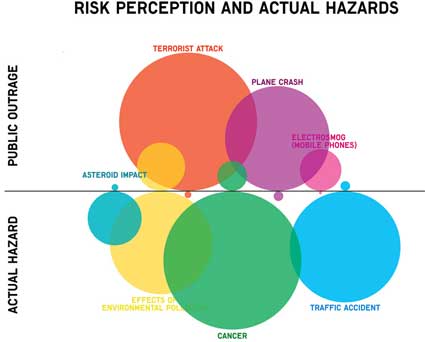
of reassurance or a real means of protection? Presumably these masks do what they claim, but as this diagram shows, the real risk of such an eventuality actually happening is small compared to the real risks that we seem less concerned about:


(3)

The way these items are sold is not necessarily ethical. It is in the best interest of the
companies marketing them have to create a sense of risk or hype up and intensify existing risk.
Are they doing an honest service that provides reassurance? Perhaps not when undeniably money is being made from people's fear.

Excerpt from 'City Survive' website:

"It is accepted by most that London is high on a list of potential terror targets.
The next attack could come in the form of more bombs bringing with them the potential for fire and the dangerous gases in smoke, or a more sophisticated attack involving chemical or biological agents.
City Survive's response to these threats is to bring you a range of compact, lightweight, easy to
carry gas masks and respirators, and our innovative City Survival Kit™, each designed to give you the best possible chance of surviving a specific terror driven scenario."


If something disasterous really did happen, having a TM on your survival kit isn't going to make it any more effective.

The rather scary look of this mask, the 'Potomac Emergency Escape Mask' (pictured) is clearly unnecessary - it doesn't need to be yellow for a start, but perhaps if it was presented with a minimal, purely functional exterior it would offer less protection psychologically? The name is also over-dramatic. Up to now we've got along fine just calling them gas-masks.

When it comes to thinking about potential impending disaster the inevitable conclusion is that the existence of however many survival contraptions cannot prevent something actually happening. If owning one helps a person sleep better at night, I guess that's fine. But lets not get too worked up.

I found an interesting example of how the design world (obviously I'm making a distinction between commercial product design (the gas-masks) and non-commercial design/art) has reacted to risk culture.
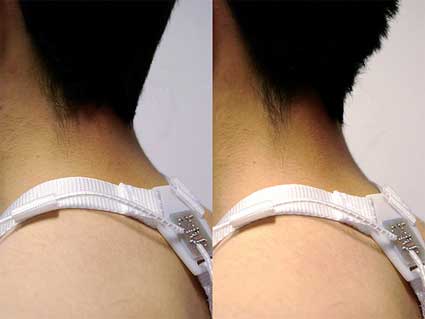
Susanna Hertrich's work at the Design Interactions department, RCA, focuses on enhancing human perception of and reaction to risk. Her piece, Alertness Enhancing Device stimulates goosebumps and makes neck-hair stand up, making the user more alert and ready for real danger. (3)


Pretty cool.

1.http://www.guardian.co.uk/uk/2001/sep/26/afghanistan.september111

2.http://www.citysurvive.com/anti_terror_gas_masks.htm#survival_kit
3.http://www.we-make-money-not-art.com/archives/2008/02/alertness-enhancing-device.php

Monday, 3 March 2008

MR. SMISH & MADAME BUTTLY RAZOR WIRE

In the following part id like to come back once more to the different roles of the designer and the artist and how they sometimes should be distinguished more clearly especially when design pieces are exhibited.
MR. SMISH & MADAME BUTTLY RAZOR WIRE is a wire fence with butterfly-shaped razors. It has been part of the MOMAs 2004 "SAFE – design takes on a risk" exhibition. To underline his critical statement about rich and poor designer Matthias Aron Megyeri presents his exhibition piece as a buyable product of mass production on his website www.sweetdreamssecurity.com. The reason why it fails as a product is because it doesn’t go to the ground of the problem. It fulfils the need to mask the growing amount of security products in our environment but it refuses to take on the real problem, which is the growing gap between the rich and the poor. The ironic nature of his statement can be already detected in his profile where he is described as a designer, „who chooses to use his products as vehicles to explore societal issues, following a critical approach closer to journalism than conventional product design.“ I’d like to contrast this piece of design with a quote of Volker Albus at „Zeitzonen 2006“ in Vienna at the University of Applied Sciences“: „Art says no, Design says no, but...“. As one of the duties of art is to question the authorities, irony is an adequate instrument to point out grievances. But design should always give an answer to a problem rather than just highlighting it. The butterfly doesn’t propose any solution to the problem. And as a product is always designed for a user it should convey a positive attitude rather than an ironic one. Sure exhibition pieces have got a right to exist but sometimes it should be questioned whether it would be possible to produce a working product as well.

–––––––––––––––––––––––––––––––––––––––––––––––––––––––––––––––
www.sweetdreamssecurity.com

design for survival

Design for Survival

With the number of ‘slums’ in developing and Third World countries rising to an astonishing amount, there has been focus on tackling the source and coming up with solutions.

In ‘Planet of Slums’, Mike Davis has a world wide political approach to the mater and presents a lot of well supported data as if to raise more awareness of the problem. He seems to make the problem a global one and ultimately asks questions of governments and political influences of the past and present. However, it’s somewhat obvious that the UN and world leading countries have a vast impact on the increase or decrease in urbanization and slums through their advances to problem solving and help strategies.

On the whole, Davis’ report is one that is most helpful when you don’t know what slums are and how they came about.

Meanwhile, some contemporary design takes the basic needs for survival for granted and focuses on making other aspect of modern life better or more efficient. This is the point that organisations like ‘design for the other 90%’ are raising through their campaigns and actions in developing and third world countries. Within their ideology they’ve split survival into six sections, Shelter, Health, Education, Water, Energy and Transport. Each one has a clear aim and attempts to achieve it in the most simplest and cost efficient way through projects supported by bigger product developing companies. Most of these projects seem quiet far fetched and sometimes miss the point like the ‘One Laptop per Child’ campaign, which ignores the use of scaffolding in an educational environment that is far behind compared to ones in the developed world.

As products, items like the portable light bag seem to be very sustainable but when you look at these campaigns as a whole the ones that work best are those that take a sustainable approach to the society they’re introduced to. Amongst other things design has the power to create culture whereby, instead of building shelter for the homeless people, you teach those people how to gather equipment and build houses independently. KickStart, a construction firm that work with other organisations to prevent poverty in Third World countries, make design solutions like the ‘latrine cover slabs’ for more affordable sanitation. The process is designed by KickSart and uses some of their products but it’s introduced in such a way that locals have overstepped the first hurdle of cost effective production and can sustain their development autonomously.

http://other90.cooperhewitt.org/

http://kickstart.org/home/

http://www.inhabitat.com/

http://bldgblog.blogspot.com/2006/05/interview-with-mike-davis-part-1.html

Artificial Natural "Give It Back"


Give It Back 
Artificial/ Natural

It is a struggle to categorise things or events into natural or artificial. One of the reasons that it is such a struggle is that it is, in itself, an artificial question. For tens of thousands of years our continual interactions with ecosystems have shaped human experience to the extent that we are no longer able to easily distinguish between what is natural and what is unnatural (artificial). The relevant question is not “artificial or natural”, but what is “of man” and what is “of nature”.

For example, when people look at a pleasant pastoral scene of honest labourers working in a field to bring in the harvest, they may think “how natural”, when in fact the opposite is true. Agriculture (probably the human activity we deem most natural) has almost completely wiped out the millions of hectares of broad oak forest that covered Europe. This isn’t a scene of natural harmony any more than the rotten cooling towers of Drax power station (singularly our largest emitter of carbon dioxide).
They are both distinctly “of man” and not “of nature” no matter how much more “natural” one scene may appear and how much more “artificial” the other appears.
Why is this distinction worthwhile pointing out?
It is a critical distinction because many people think that a return to some idyllic pre-industrial setting will save the human race from the trauma of global warming, but while this idea may be romantic, it may also be deluded.
Industry and urbanisation (“artificial” and evil) are usually singled out as the great contributors to the impending problems of the planet. While this is true, the greater truth is that agriculture (so called “natural” and good) is equally a significant threat to the planet. We imagine that factories, roads and houses blight the U.K. when agriculture in fact covers 70% of the country compared with only 14% for urban and suburban areas. That coverage leaves very little room for forest and woodland (12%)to act as either carbon sink or wildlife habitat.
We urgently need to return both urban and rural land to managed wilderness to help absorb carbon dioxide from the atmosphere and to reduce the pressure on habitat that threatens wildlife everywhere. This means that we must live more densely (urban as opposed to suburban) and that agriculture needs to be more efficient (more food per hectare) and more effective (more crops for people and less feed for livestock) so that we can start the long overdue process of giving back land to nature for reforestation and the reintroduction of threatened species.
Most of all we need to think clearly about the changes needed to improve this planet and not fall for emotive and arbitrary distinctions between what is artificial and what is natural, as it hasn’t been a relevant question for some time.
Humankind stepped beyond natural thousands of years ago.

http://www.telegraph.co.uk/earth/graphics/2007/11/14/eapower114.jpg
www.hayinart.com/2004_10.html
Statistics from D.E.F.R.A.


Supplement to the post below

'if it is our basic human nature to annex, exploit, and incorporate nonbiological stuff deep into our mental profiles - then the question is not whether we go that route, but in what ways we actively sculpt and shape it. By seeing ourselves as we truly are, we increase the chances that our future biotechnological unions will be good ones.'(Clark, 2003)

Artificial or natural?

People, have always liked to categorize things. Good and bad, moral and immoral, artificial and natural.

You may think that artificial and natural have a more clear distinction then something as subjective as morality and you may be right. However the beginning of the industrial revolution seems to have initiated the time when people first stepped way past their limitations. Mass production was invented and instantaneously one person could do the work of fifty.

One person doing the work of fifty, with the aid of a machine, or is it a machineperson doing the work of fifty people. We have cyborgized ourselves, adding to our ability’s. The question is, has this made us artificial? Or are we ourselves still natural but the technologies we use artificial, even if those technologies are placed within us?


(http://static.howstuffworks.com/gif/artificial-heart-abiocor-hand.jpg)

This is clearly debatable, surly though changing the very essence of what makes up an organism, its genes, is not debatable. You create a hybrid and this hybrid can only be called artificial or at the very least ‘man-made.’

However the insertion of new genes to produce wanted traits in an animal or crop is not a new idea. For century’s farmers have chosen the strongest, fittest, fattest of their live stock to breed in order for the next generation to be stronger, fitter, fatter. A form of controlled evolution if you will.

Even farms themselves haven’t always been around, the fact that farms are there at all has changed the landscape and habitat of the area, it has changed behaviors of animals, even pushed some animals to the brink of extinction and yet we have been almost re-programmed to consider this natural. Could extinction ever be considered natural?

As the modern world progresses we have gotten more and more ambitious with our ‘projects,’ now there is even talk of pharms where you could literally farm pharmaceuticals. Now even tobacco, the hailed bad guy of the crops could be responsible for saving about 10 million people from contracting HIV in Africa. Ironic, insane, irresponsible, incredible, ingenious. Are among the many things I could say about this project.

'Pure good is pointless, absurd, and, wherever there is a purpose for anything, you will find the Devil lying in wait.'

Vilem Flusser's quote that some of you may agree with and some may not. But certainly rise the question whether are all our pursuits that we are making, with all our knowledge and noble wisdom really aiming for good.

Here are the two examples of 'fighting-talk' to abandon the fur 'application' in Fashion industry with different points of view. One, as we all may know and be aware of is www.peta.org/ against animal cruelty, and their typical ad ...

<
Engaging with what we feel when we see this image, we must think beyond our comprehension and think not only of a 'Total Animal Liberation' but also contemplate with our violent tactic, blackmailing and bogus political campaigns.


Whereas, the picture below is showing the models in striding to a rather alarming mix of bleats and beats ...
>


Bear in mind that Jean-Paul Gaultier's recent show for Paris Fashion Week played Michael Jackson's 'Thriller' song in the background competing with animal calls blaring over the speakers. Yet Gaultier's clear courting of controversy detracts from his notable fur-free creations. Was he unleashing the other side of human showing who we really are or was he just taking the piss while PETA seethes?

<
Here is another example of PETA's campaign targeting children to seduce them into believing in their vision by seducing them with comics, and they are providing teachers with biased lesson plans and doing seminars at schools.

One more quote on Ethics and Morality ...
'Even if animal tests produced a cure for AIDS, we’d be against it.'
PETA president and co-founder Ingrid Newkirk, in the September 1989 issue of Vogue, Sep 1989


We need to acknowledge for ourselves whether 'are we on the way from or to the first principles' (Plato) before we can judge.

Let the 'other' 90% design for us

[Time and Design]


Each second, minute, hour of our day is conducted by the culture that we inhabit. In our western society time organizes even constricts our lives, we manage our time by what’s happening right here, right now and we tend to focus on the individual rather than the wider community; according to our western economic thought ‘time is money’. The book ‘Eternally Yours’ begins to question whether this in tern effects how we disconnect ourselves from long-term sustainability.

It is undeniable that we live in a throw away culture, which is reflected in the way our culture approaches time. “We can see the past but we can’t influence it. We can influence the future but we can’t see it”
[1]. This example illustrates how we don’t design for the future but for now, and as consumers we demand and push this cycle. Design for the other 90% looks at ways we can make a small sustainable intervention into a less developed country or society. However have we ever stopped to question that they survive by being sustainable; where as we survive by designing the next throw away item. Perhaps it is time we took some of their practices and reflected them into our culture.

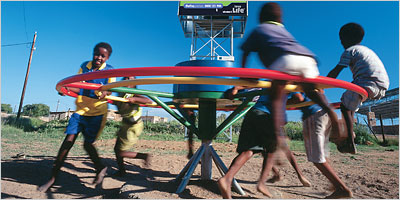
One sustainable project that was implemented in small communities in southern Africa looks at children’s ‘play time’. “The zero energy pump is specifically designed playground roundabout that pumps groundwater from boreholes into sealed tanks”[2]. This intervention is powered by the children having fun and turning the roundabout. It raises groundwater as much as 1400l an hour. The programme is funded by the advertising for public health companies which also encourages local businesses. This example illustrates how time links hand with fun and produces a sustainable object, and ultimately benefits a community.

Is it time that we let ‘the other 90%’ design for us. If they are capable of living along side nature, then we can too. Time and sustainable design go hand in hand; if we were to change our ideals of time then perhaps sustainable design will just become that of the norm, rather than a fashionable commodity.

[1] Hite, E. (2004) Eternally Yours Time in design. olo publishers, Rotterdam.
[2] Cumberlidge, C and Musgrave, (2007) Design and Landscape for People, Thames and Hudson, China
Image:
http://www.tablarasagallery.com/assets/images/playpump.jpg

Artificial Natural: Summer All year-round

One year consists of four seasons, winter, spring, summer and autumn. As the season changes, the temperature naturally changes and the activities that individuals do will change as well. Different places in the world have certain climates in order to allow particular activities to occur, E.g. Hawaii for surfing


In the nature of human beings, we will do certain activities led by the climate, but excluding places like Seagaia Ocean dome in Southern Japan. The Ocean dome was build in 1993 and it is recorded as the largest indoor water park. The Ocean dome has a controlled temperature of 28°C to 30°C in the water for all year-round. However, controlling the temperature of the indoor swimming park does not fulfill its theme of being an ocean. Therefore, a wave machine is used to give waves for the surfers, flame-spitting volcano is planted onto the landscape, retractable roof to open up in sunny days and close up is a blue sky ceiling in bad weather. This Ocean dome also used technology to crush white marble into sand, so it would not stick onto your skin. All these artificial products was used to imitate a real beach, to let people experience a summer beach time whilst the weather naturally does not allow them to.
As a result, millions of people visited this artificial beach. They are able to visit the Ocean dome in winter, as it can produce the same time excitement people have about summer. Although this excitement about enjoying the summer in winter time fades. This is because no one will look forward to summer anymore, because going to beach will no longer be the advantage of summer as they can experience it in the winter.
Since the Ocean dome was built, indoor water parks have been increasing around the world, such as the Tropical Island in Berlin. As a result, individuals no longer look forward to summer and feel excited for the change of the season due to the increase of artificial natural manufacturing.

http://www.impactlab.com/2006/03/02/japans-indoor-man-made-beach/
http://www.japannewsreview.com/travel/20070605page_id=71

Design for the other 90%

It could be argued that designing for ‘the other 90%’ is patronising and demeaning as it’s a western approach to solving a third world problem, dealing with complex dynamics that are often alien to our own. However, it is impossible to deny that although we are a long way off amending the bigger picture, small design interventions can make a huge difference to the quality of life in desperate times and situations, and some interventions, such as water sanitation facilities are unable to fall into the category of interference as it is a bare necessity for everyone.

‘Each year 2.2 million people die from diseases caused by lack of safe water and basic sanitation. The nature of the contamination is varied, viral, microbial, parasitic and chemical contaminates all contribute to this staggering death toll’1. Red Button Design have designed a water sanitation, transport and storage device for this specific problem – known as ROSS (Reverse Osmosis Sanitation System - seen below). It is aimed at the developing world, where clean water sources are not locally available. ‘The user would roll the ROSS unit to the water source and fill the tank before pushing it back to the community. As the device is moved the mechanical motion of the wheels drives a filtration system through the tank. Clean water can then be stored in the vessel and dispensed when needed’1.


This is just one of the many thousands of designs out there, trying to tackle current issue; undoubtedly many more designs will follow and it is important this trend continues.
1 http://www.thisisredbutton.co.uk/index.php?mod=ross
Images- http://www.thisisredbutton.co.uk/index.php?mod=ross

Artificial Natural

[Can we be classed as artificial?]

Mother earth ‘as the giver & sustainer of life’
[1] has allowed us to explore, create, learn and play within her nurtering arms. However as time and technology have progressed we have become witness to our ecological footprint, and its consequences are becoming more apparent to the naked eye. It is obvious that the “Earth’s ecosystem cannot sustain current levels of economic activity and material consumption”[2]. It begins to pose questions of what is natural and whats not, and where that divide lies.

The boundaries between the artificial and the natural are becoming increasingly undistinguishable. This division is continually challenged to question what is organic in comparison to that which has been tampered and played with. What is natural and what is artificial. An example of this can be identified if Klara Orosz’s work.


The Gallery ‘Ternderpixel’ which launched on the 15th of September showcased Orosz’s most recent work from graduating at Goldsmiths. It ‘invited spectators to sit, touch and play while blurring the natural and artificial boundaries’
[3]. The installation used a combination of wood and faux grass to create a network of sofas which allowed people to interact with the material used. It was designed to question the contrast between the natural and artificial boundaries, and also the natural within the artificial.

With this subject in mind it can be questioned whether man itself could be classed as artificial. Le Mettrie’s once stated “Man himself is a machine”, which could be illustrated by the developments in technology and the mechanized drive behind our constant desire for what’s ‘new’ or ‘fashionable’. It also reminds us of the concept of Stelarc’s extra ear, which asks the question- at what point we as humans become artificial? Is it by those objects that we consume, or by those that we depend on? Are we simply turning into a collection of commodities?


[1] http://en.wikipedia.org/wiki/Mother_Earth
[2] Wackernagel, M and Rees, W. (1996) Our Ecological Footprint. New Society Publishers, Canada
[3] http://www.tenderpixel.com/october.html

Artificial Natural

Where is the line between natural and artificial? For thousands of years humans have been playing with the idea of natural, and food production is a great example. Farming and selective breeding on a basic level is artificial natural. The use of GM crops, and the creation of ‘natural environments’ is taking this a step or two further. Is it right that in supermarkets we can find most fruit and vegetables all year around, regardless of seasons?

Tomatoes undergo breeding programmes in order to make them bigger and redder 1. This is just for the shelf. They are more appealing to the majority if perfect, it’s now expected that food available is in perfect form, and many people when shopping judge the aesthetics of what they are buying – rummaging through what’s available, looking for the most uniform selection.

Now not only the colour and size of fruit is altered, but also the shape. With what is considered a consumer driven solution to a natural problem, watermelons in Japan are on sale in cubed form 2. The idea behind this is that the fruit is now more easily packed, stored and eventually cut. These watermelons are however in some cases triple the cost of a regular watermelon, making them fashionable food, and available predominantly to the wealthy. If food production falls under the artificial natural category, is square fruit really a big deal, as it is just an extension of what is already implemented on a global scale? Or are there limits to what humans should interfere with?


1 http://news.bbc.co.uk/1/hi/world/asia-pacific/1390088.stm
2 http://www.bioethics.upenn.edu/highschool/Webfair/?v=2

Image:- http://news.bbc.co.uk/1/hi/world/asia-pacific/1390088.stm

'Qualified' Social Commentator

Alfredo Jarr is currently showing at the South London gallery, he is a Chilean artist working in New York.

I went to see his show on Saturday and became interested in his work titled 'The sound of Silence'; this work deals with the ever debated issue of documentary photography and it's seemingly necessary relationship with suffering.

The film looks at the Pulitzer prize winning image by Kevin Carter of a famine victim overlooked by a vulture (see right).

The film is a poignant view into the history of the photographer; his background and experience of fighting, how, and why he came to be a photojournalist. However most interestingly to me it dealt with the criticism Kevin Carter felt as a result of selling his photograph;

"The man adjusting his lens to take just the right frame of her suffering might just as well be a predator, another vulture on the scene."1

The public wanted to know why he did not intervene and help the child. Perhaps this criticism was a factor that led to his suicide shortly after receiving the Pulitzer prize for this image.

I was thinking about when "designing for the other 90%", and designers insistence to design to raise awareness, and the implications this has. As Jaar would seemingly argue (from the slant of his film) Carter may not have saved the girl he was photographing, however by raising awareness of the situation maybe this can or has had a more felt effect.

I was trying to work out, if a room full of us talking about designing for the other 90% was hypocritical, and whether or not this highlighted the problems of a global design; the title, design for the other 90% suggests (by using a statistic) you do not know these people, what they want, how they suffer, and so on.

In which case, the only thing we can really do is raise awareness? Can we even do that? Carter had grown up in South Africa and had fought twice- he had experienced war, seen murder, and starving children, maybe he was 'qualified' as a true social commentator on an issue that was unfolding around him.

I feel this is a difficult subject, obviously any attempts to raise awareness of current political issues are important, and as artists/designers we are social commentators, but i would also like to think one has a little more potential to shape futures rather than simply telling people what is going on, especially when we don't even know.


'The Sound of Silence' is showing until 6th April 2008: http://www.southlondongallery.org/


1 http://www.thisisyesterday.com/ints/KCarter.html

Sunday, 2 March 2008

Nature Can Heal


As we head towards the start of a great and large ecological movement, we realized that people are all in all at the mercy of nature. Humans creates and redesign tools in nature that functions. By doing so, humans acknowledges that there is in fact a gap between people and nature. In this respect, we have all be mistaken. As the planet dies away, we are realizing that humans are not god.

"We are first and foremost biological beings."

By creating cities, we have moved ourselves from what our human bodies are used to and instead, into an alien setting where everyday our bodies are challenged to the max.

“Our health is precariously connected to the natural ordering system of the planet. The man made environment should fully realize this connection and support the users health.”

Today’s world, architecture is seen as the battle between gravity and imagination and an understanding of sense and space. No longer is architecture about adapting to nature. It is now seen as an adaptation to cities.
Citing
Cooper, Graham. Art and Nature: Healing . Book Art and Architecture, 2006. Epping Green Hertford, UK.

Friday, 29 February 2008

Slow Design

Slow Design is a growing creative movement and a way of thinking. Its basic concepts revolve around the idea of holistic and thought-out design which is responsive and responsible to and for its environment.

Slowness … describes the individual's elevated state of awareness in the process of creation, the quality of its tangible outcomes and a richer experience for the community it engages.”

A work of Slow Design which draws directly from the theme of time is Thorunn Arnadottiri’s ‘slow clock’. It is a wall hanging clock which is made up of a cog and a long string of beads. Each bead represents five minutes of time and the hours are marked of with red beads rather than blue. This cyclical representation of time is a recurring theme in the field of ‘slowness’ and the incremental changes are also a favourite feature in the slow scene. The effect of having 5 minute intervals of time is a calming one and sets a slower pace for the user. The beads can also be completely removed and worn giving the wearer freedom from time.

Sustainability in lifestyle is key to slow design, not just ecologically but psychologically and emotionally too. Carolyn Strauss and Julian Bleecker’s ‘slowMail’ is a project which takes a normal email and analyses all sorts of real data about it: the physical distance from sender to recipient, the relationships involved and even the actual content. SlowMail uses this data to slowly send your mail over a long period, even slower than regular mail. The system aims to establish a less frantic, calmer form of communication and to create ‘a new rhythm of social interaction’.

I’m really taken with the idea of slowness, it hints to craft, and care, and most importantly, thought. The poetry which often seems wound up in these projects creates beautiful outcomes filled with narrative (a good amount of them are concerned with a prolonged system or the life span of a product) and most have the sense of adaptability and change built in to them. I think if we keep up the pace of life which modern society is dictating, then we’ll burn ourselves out, both in the literal global warming sense and also in the personal human sense. Stop the world I want to get off- if that’s not possible the least we can do is slow it down.

http://www.slowlab.net/

http://www.thorunndesign.com/

did you know that when you do that


Future Farmers, Harvest, Systems Design Limited, Hong Kong, 2002

Slums and that


In the General Public Agency Book there is a project in India which talks about slum networking. It’s a concept which uses natural drainage paths in cities to transport water and waste and recognizing that many slums are built in lower parts of the city near water courses. The system uses gravity rather than pumps and does not require deep excavation, therefore being cheap. The main part of this project, as I see it however, is that the city recognizes the residents and their homes as places to be networked and thus treats them with the same respect as richer citizens. Every home is given a toilet and running water.

“gaining working infrastructure of a standard equivalent gives slum dwellers the incentive to improve their own homes”

“after only five years, the former slum area… is indistinguishable from the ‘normal’ neighbourhood.”

Another infrastructure led scheme is being created by a UK based charity called ‘Hope Through Action’. It has recently started a project in Mbekwini, a poor township in South Africa, which is hoping to help all sorts of social problems. It’s aims are:

  • An increase in awareness of HIV/AIDs and its prevention
  • A growing self belief in individuals and the community
  • A significant increase in individuals’ health and self esteem
  • An increase in community pride and participation
  • An opportunity for different communities and racial groups to work and play together in harmony
  • A reduction in crime and unacceptable behaviours

It hopes to do this through the seemingly irrelevant act of building a football stadium in the township. It has been the product of a lengthy collaboration between the UK charity and the South African locals and throughout, decisions about the design, building and running of the stadium have all had input from the South African side of the relationship.

The interesting similarities of the projects are that they are both use simplistic forms of intervention to create a massive change. The India Networking project uses the lands natural topographic waterways to create a cheap and lasting infrastructure and the Football Stadium uses creating a shared space as a way of creating civic pride whilst the recreational activity gets young men (the key ‘problem’ demographic) ‘off the streets’ and is also a good platform for educating about health issues (the educating would be undertaken by local authorities). Both projects also utilize the local knowledge and listen to their needs and wants- this creates a lasting system which wont fade when the battery runs out, or the designer goes home- it becomes self sufficient and relevant.

I think that systems are more effective and appropriate in these slum areas- their aims are not to impose but to give people the tools to help themselves. Clever planning and good communications and collaborations will always work better than a quick fix.

India images and quotes: Clare Cumberlidge & Lucy Musgrave, Design and Landscape for People: New Approaches to Renewal, Thames & Hudson, 2007

Bullet Points: http://www.unitedutilities.com/?OBH=5674

HTA logo: mine under development

Artificial Natural


Heather Barnett
Cellular Wallpaper
Interior Narcissus Collection developed at Poole Hospital 2000

The boundaries between the artificial and the natural are becoming more and more difficult to distinguish. Our definitions of ‘Artificial’ and ‘Natural’ as concepts are therefore under construction. The concept of natural might have previously been thought of as something ‘organic’ or something ‘grown or produced in the countryside’, might now be thought of as something ‘based on’ or ‘influenced by’ nature.

This blurring of boundaries is not necessarily a negative thing; it conveys the constant evolution of concepts, ideas, conventions and language. So what will this constant evolution mean for design? Maybe Stelarc’s ‘Extra Ear’ will be standard and designers will be expected to experiment in the scientific to find new solutions to an evolved generation of problems.

Rather than researching into the newest scientifically innovative design project I decided to look into the blurring of natural and artificial boundaries in existing design projects. I came across the work of Heather Barnett, an artist working “at the intersections of art, science and education.” I found her ‘Cellular Wallpaper: Interior Narcissus” project particularly intriguing. Barnett designs wallpaper patterns by artificially enhancing the graphic design apparent in nature. The examples shown are “designs derived from human cellular microscopy.” The first example, Rosebud, is a magnified graphic of a cervical smear, and the second and third examples, Kaleidoscope and Peach Blossom are magnified blood samples. This subversion of intimate human cellular imagery through artificial means result in beautiful repeat patterns that are reminiscent of historical chintz designs. Although they are artificially enhanced the wallpapers convey nature’s strength as a designer in its own right. Barnett’s work may not be a feat of technological genius but is thought provoking and gives an insight into the natural world that cannot be seen naturally by the human eye. Although the subject is natural, its representation can only be seen using artificial tools, for example a microscope. As Marshall McLuhan would agree, a microscope is the man made extension to the human eye, therefore it would be classified as artificial, without it however human perspective on the natural world would be restricted.

The natural world has always influenced fields such as art, design and science and will always be a rich source of inspiration, it is natural to look to the natural and our investigations are commonly led by or informed by the artificial. The relationship between the two can be harmonious or disastrous and rarely fails to be informative.

Ester Kneen

http://www.heatherbarnett.co.uk/cellularwallpaper.htm
Hanaor,C(2006)The cutting edge of Wallpaper.London:Black Dog Publishing

Tuesday, 26 February 2008

Artificial Natural: Sk-interfaces review


TISSUE CULTURE & ART PROJECT/O. CATTS & I. ZURR

Artificial Natural: Stelarc Event

6.30pm Friday 29 February 2008
Cruciform Lecture Theatre 1, Gower Street, London, WC1E
Bartlett School of Architecture International Lecture Series

Stelarc
Artist

'Stelarc is an Australian artist who has performed extensively in Japan, Europe and the USA- including new music, dance festivals and experimental theatre. He has used medical instruments, prosthetics, robotics, Virtual Reality systems and the Internet to explore alternate, intimate and involuntary interfaces with the body.'

'He has performed with a THIRD HAND, a VIRTUAL ARM, a VIRTUAL BODY and a STOMACH SCULPTURE. He has acoustically and visually probed the body- having amplified brainwaves, blood-flow and muscle signals and filmed the inside of his lungs, stomach and colon, approximately two metres of internal space. He has done twenty-five body SUSPENSIONS with insertions into the skin, in different positions and varying situations in remote locations.'

'For FRACTAL FLESH, as part of Telepolis, he developed a touch-screen interfaced Muscle Stimulation System, enabling remote access, actuation and choreography of the body. Performances such as PING BODY and PARASITE probe notions of telematic scaling and the engineering of external, extended and virtual nervous systems for the body using the Internet. Recently for Kampnagel, he completed EXOSKELETON- a pneumatically powered 6-legged walking machine actuated by arm gestures.'

'Current projects include the EXTRA EAR- a surgically constructed ear as an additional facial feature that coupled with a modem and a wearable computer will act as an internet antenna, able to hear RealAudio sounds. And MOVATAR is an intelligent avatar that will be able to perform in the real world by possessing a physical body. It will have a sound feedback loop from the body giving the virtual entity an ear in the world.'

'He has also completed an EXTENDED ARM- a manipulator with eleven degrees-of-freedom that extends his arm to primate proportions and a MOTION PROSTHESIS- an intelligent, compliant servo-mechanism that enables the performance of precise, repetitive and accelerated prompting or programming of the arms in real-time.'

'The Bartlett School of Architecture International Lecture Series is a free event and everyone (including non-students) is welcome. Tickets are not required and seats cannot be reserved. For up-to-date information please visit the website www.bartlett.ucl.ac.uk/architecture/events/lectures/lectures.'

Tuesday, 19 February 2008

No Exit: Ecological Limits and Climate Change


Global temperatures are expected to rise by 1.4 - 5.8° Celsius by 2100. Global temperatures have already risen by 0.6° C above pre-industrial temperatures. [1]

Actually everybody knows about climate change and its potential consequences. You are bombarded with information about it all the time and you can hardly escape from it. There are plenty of advertisments and many discussions about this topic and more and more people question this problem.

But why then has it taken such a long time for awareness of the problem to be raised? Nobody feels responsible for it although there’s such a flood of information. Although you hear all the time that it’s up to you to change something, you don’t realise that you could really contribute to the solution because you can’t see any immediate results. Human beings need to feel under threat to realise the problem and its risks and change their behaviour.

Often panic has to break out to raise awareness. That has happened already in other fields, one example of this is recycling. People needed time to understand that it’s important to recycle their waste, and so today it’s normal and everybody knows about the urgency to behave in an environmetally conscious way.

In my opinion people just need time to understand the problem of climate change and by and by they will start to do their best to cope with the problem.


____
[1] Intergovernmental Panel on Climate Change, 2001.

Panic Buttons


It’s mankind’s instinctive need to feel safe. People will do everything possible within their power to maintain this feeling. This strong desire for protection is often combined with the fear of loss or of getting hurt physically or psychologically. This existential fear easily causes panic, leading to the creation of a scenario of risk. The essence of risk is not that it is happening, but that it might be happening. [1] Risk operates outside the capacity of human perception, invisible and often unconscious.

In many instances the government, the media and insurance companies play with this natural fear, spreading panic strategically in order to pursue their own interests. It is used as a tool to raise awareness of issues, especially those of a political and environmental nature. As the use of fear to influence people produces a strong effect, it’s important to prove its use is responsible to prevent misuse.

During the second world war, for example, the fear of losing one’s livelihood was used for manipulation and propaganda. These days it is the fear of terrorism and the potentional for a nuclear war that play a big role. Another example is the American Government’s use of fear in its tv advertisments to encourage people to join the army and appeal to their sense of coherence and patriotism.

http://www.youtube.com/watch?v=qAp-VdBkIDE&eurl=http://www.freeunibz.net/blog/?p=1894

Panic buttons can be found in many different fields. The use of the right stimuli can motivate people to change their behaviour and reflect thoughtfully about themselves, their environment and their future.


____
[1] Barbara Adam and Joost van Loon, „the risk society and beyond“, 2000

No Exit: Ecological Limits and Climate Change


“What country is the largest source of global warming pollution?

The United States. Though Americans make up just 4 percent of the world's population, we produce 25 percent of the carbon dioxide pollution from fossil-fuel burning -- by far the largest share of any country. In fact, the United States emits more carbon dioxide than China, India and Japan, combined. Clearly America ought to take a leadership role in solving the problem. And as the world's top developer of new technologies, we are well positioned to do so -- we already have the know-how.”

http://www.nrdc.org/globalWarming/f101.asp

The White House only recently accepted that Global Warming is happening
For a long time the facts of Global Warming provided by scientists were altered before publication in order to play down the threat of global warming for the public.
When George W Bush was asked what was being done about the Global Warming, he avoided answering the question and said:
“The Globe is warming. The fundamental debate is, whether it’s man made or natural.”
The power is in the Governments hand and we only get the pieces of information that were chosen for us, the ones we are allowed to know. For a long time there was confusion about Global Warming being real or not. It is real, now we know that!
Scientists were and are being controlled by the government and are being silenced if they have something inconvenient to say to the public.
This is how I see it: Scientists have the facts Designers have the skill to provide it to the public in ways that the Government would not intertwine.
However this raises debate whether the public would believe anything that is not evidenced in great detail for them and if is not published in a daily newspaper on the front page? It is important to raise credibility in our society and with designs spread the word that global warming can be slowed down and probably the Earth can sustain itself for a little longer, than it can with the climate changes of today. Yes, the government has the power to do something about this, but we can all do our little bits to try and make it better. To communicate these ways and to make being friendly for the environment an attractive and if possible a fashionable option is the designers job.

Image: http://creative.myspace.com/groups/_ag/climate_code/images/TWC-CustomCommunity_PSD_-09.jpg

Sources:
Climate Conspiracy or Global Catastrophe – BBC 4 (14-03-2006)
Panorama: Global Warming – BBC 1 (04-06-2006)

No Exit: Ecological Limits and Climate Change


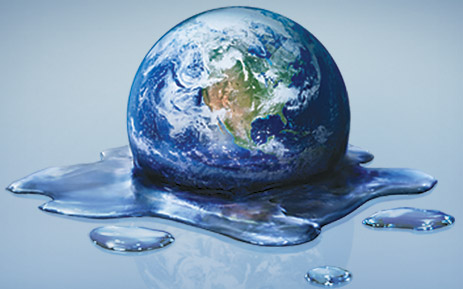
Despite the fact that climate change is happening faster because of human activity, popular media reports doubt causing a public opinion split between admitting or denying our role in the acceleration of climate change.

The media’s influence on public opinion is huge and according to Al Gore’s film ‘An Inconvenient Truth’ popular media show doubt in 53% of their reports on climate change. When art and design interacts with the media they can produce a new and innovative way of communicating a message. If art and design were to work with science to communicate the truth with objects and images, this doubt could be undermined. It is true that climate change is inevitable in the Earth’s natural lifecycle but ‘the challenge of anthropogenic climate change is that it is occurring on time scales short compared to the ability of societies to adapt easily.’1 The human race has caused climate change to accelerate at a rate our evolution as a species and society cannot keep up with. Gore argues that ‘we can no longer afford to view global warming as a political issue - rather, it is the biggest moral challenges facing our global civilization.’2

Yet still there are skeptics, but whilst watching ‘An Inconvenient Truth’ I became hopeful that everyone could be convinced and ‘real’ action could be taken. Gore uses humour and showmanship to undermine skeptics along with strong and convincing graphics such as the so-called ‘hockey stick graph’. He mixes personal experiences and scientific information, the sort of approach which could be innovatively communicated by an artist or designer. It seems that public opinion is most influenced through design, be it fashion or object, so it is logical to use this medium for communication.

Communication design can help the public to distinguish between popular media’s false doubt and scientific fact, ‘the problem also is with the content and methods of science, we must rethink the ways that science is carried out, and how it is organized within our societies.’1 This is where I believe our role as designers can be played out.

1 ‘Lovely Weather: Asking What the Arts Can Do for the Sciences’ by Roger F. Malina in ‘Ecomedia’ 2007

2 www.climatecrisis.net

Image: http://youmaybegreen.com/wp-content/uploads/2007/04/global-warming-earth.jpg