What really builds a person or family’s sense of security? This is a topic that came up through my investigation of the Heygate Estate; a studio project I undertook this year.
I asked each dweller if they felt safe now the estate has been left to deteriorate and is so sparsely occupied. The astounding and overriding answer was yes. When they are in their carefully nurtured homes they feel perfectly protected, no one reported a break in or disruption.
The majority of people I met have lived on the estate for over 30 years. They harked back to a time when The Heygate was an ideal place to live, an urban utopia.
Corbusier learned the aesthetics of functionalism (the beauty of a carefully calculated structure sans ornament) and the positivism of the modern age.
http://www.uky.edu/Classes/PS/776/Projects/Lecorbusier/lecorbusier.html
Built on the back of Corbusier’s theories and proposals, Heygate went by the Parker Morris Committee- a report which concluded that the quality of social housing needed to progress to match rising living standards. It gave a number of suggestions, giving each home realistic space for furniture needed with what we would now consider ample space to go about normal living/household activities.
If the estate is rejuvenated and modernised it has the potential to be a great place to live. Although some might wish to forget the striking effect these buildings have on their surrounding landscape, they are a pivotal example of post war architecture. Haunting and striking they may be, but they have come to represent the area, to be the area, for better or worse.
Most residents that remain are unwell/old/alone and feel they simply can’t manage the move and will lose their support network. Those in good health are fully aware that when they move they leave behind their homes, friends, community, security, and step into the new world fuelled more than ever by fear power and possessions.
Friday, 27 March 2009


At first this is seen as a humorous lighthearted and human approach to the redesign of harsh and traditional security measures. I imagine a city where all of the existing precautions are replaced by a Sweet Dreams Security approach. This would certainly brighten up all of our days but what effect would it have for our children and future?
“One of the features which distinguishes human being from other animals, Barthes maintained, was the fact of their having had a childhood”
Introducing Barthes. Philip Thody, Piero. introducingbooks.
The signs, symbols and imagery that surround us remain in our consciousness and form early opinions of what type of world we live in. However, is there really any need for so much hardware?
AFFLUENZA
ECOLOGISTS MAINLY FOCUS on the damage being done to the planet by advanced industrialisation. I come at the same problem from a different direction: the damage done to our emotional wellbeing by the particular form of advanced industrialisation which many call neo-conservatism or market liberalism, championed by the USA.
My conclusions are the same but via another route: we must declare an end to profligate mass consumerism not only because of the damage to the planet but because of the damage it is doing to people.
Affluenza by Oliver James, Vermilion, 2007.
Perhaps we would encourage an even stronger, more human minded generation of children if they grew up surrounded by fewer symbols of overt restriction, intimidation and violence. Will this generation then go on to be less suspicious, more positive, happy and trusted?
Do these objects and structures actually enhance ones safety or even work as a deterrent for criminals and people wishing to break and enter etc?
My belief is that by and large they work for the user/customer in way that reassures their psyche.
The harm in this is that we continue on in being a scared nation at the mercy of our murky government. The items lay in a slightly grey area where one might believe to be doing something ethically and morally correct, but through an act of buying something new. Affluenza intervenes at every moral stage.


BASF - What are you getting at?
I'm sure most people have seen the BASF Invisible Contribution adverts on TV. The question that springs to mind after watching them is who are they and what on are they trying to achieve?
So what happens when you decide to find out a bit more?
If you Google "BASF" the top few links go to their website with a spinning globe with paper buildings and it's all very friendly and warm. Maybe they feel a bit neglected and want people to know that they're there, or maybe they want people to go to their UK website and read about the super efficient eco-house they've just built and how green they're trying to be. The 4th link however, is the Wikipedia entry where just after the introduction you can discover that BASF used to be part of IG Farben who made the Zyclon B used in the gas chambers of Nazi Germany.
Perhaps they were trying to shake off their shady past and recruit some bright new graduates, but their adverts tell you nothing about their green efforts, only how they've touched everything you own with their chemical mitts. It's a very strange move for a company that churns out petro-chemicals, plastics and pesticides like there's no tomorrow - especially when we're all trying to get away from them.
Leave the planet alone
 Like human body, the earth has an amazing capacity to heal itself. An outstanding example of this occurrence last century. In the 1883 the Indonesian volcanic island of kraktau (Krakatau) erupted in a gigantic explosion that was heard almost 1000 miles away. Nearly five cubic miles of the matter was hurled into the sky, and two third of the island disappeared under the sea. Nine month later the only sign of life was a microscopic spider. Today the whole island is covered by exuberant tropical vegetation, which is host to hundreds of species of birds, mammals’ snakes, and insects’ .No doubt this recovery has been abetted by the protection the island enjoys as part of ujung kulong National park. Human damage can also be undone .Given time the earth can heal itself. The question is, will men give earth the respite it need? Probably not. But there is someone who is determined to let our planet heal itself (the one who create it).God never intended for men to ruin the earth. He told Adam to ‘cultivate and take care’ of the Garden of Eden(Genesis 2:15)
“machinery enables no more of us to live; it only enable more of use to live idle on other’s misery’ and secondly –‘most assuredly, the soot and stench of your engine will make your crop less year”
Ruskin
Utility reassessed ,Judy attefield pg.12 -15
Utility reassessed ,Judy attefield pg.12 -15
Linda coleing describes wrote an essay on venture of john Ruskin st George mill laxey, Isle of Man. In her account of the mill, which produce homespun fabric .She presented it as an example of ethical design. Ruskin is portrayed as an early environmentalist who helps to run his enterprises without steam power and who planned to establish a large scale based on production. When building the mill Ruskin has the intention to use only wind, water, animal and human power. His ethical behavious has set a role model for a lot of designer today.
Godfrey,
(Due to some techincal difficulties with my account , i am posting my blog with james account)
Godfrey,
(Due to some techincal difficulties with my account , i am posting my blog with james account)
Climate change and ecology
 The Air and Rail tycoon, Branson come up with his genius idea in publish Friday, 9 February 2007 on the bbc website,offering 25 million for those who can come up with the best idea to remove carbon dioxide (CFCc) from the atmosphere. Sound like a good idea to me, but I personally not worried that we will suddenly remove too much CO2 from the atmosphere. Whereas my biggest concern is that even a very modest effort like this would be used as an excuse to keep burning coal in the filthiest way possible and actually make things worse.
The $25 million on the other hand, I have confidence it will help motivate funding for the people already working on the problem, and might get some innovative idea off the drawing board a little faster. Even if atmospheric carbon sequestration isn’t the most efficient solution, it might help, and even if it turns out a complete letdown,the global warming fight only lost $25 million. There will be plenty more money in the coming years, and in the meantime, this prize has gotten global warming a lot more press. Seems like a win-win solution for me, therefore I don’t see how Branson’s offer can hurt.
Every l bit helps, and along with alternative energy, reduce, reuse, recycle, and planting real trees, this type of thing may become a part of the overall solutions package. But it won’t solve the problem. It will only help a little. Solutions to excessive emissions require first and foremost changes in behavior by all of us. The unfortunate desire (which we all share) to rant and rave, to be right at the expense of others, and to keep fighting yesterday’s battles can stop us from achieving our goals.
Godfrey,
( I am posting this blog with james account due to some techincal difficulties with my current account)

Design for the OTHER 90%
WHAT IS THATTTTTTTT?????
Who is this 90% and who is another 10%? Is this a crossed line between US and YOU? Is this an social attack? Ethics... About what ethics we are talking NOW? It is an absolute bull shit. Oh.. And I have to admit, that this screaming title was the only reason I picked this book up. Clever marketing? I guess...

Katrina Furniture Project????? Branding vs Slums, w here loud names are over-shining the real notion of the project and the notion of the ‘real life’. Is this ethical to establish your design brand, using global disasters as tool for advertising? It is humiliating, and un-thought, to get into people’s hearts, when something was taking out of them. And did we ever think that erupting into slums, with our great inventions, we can be misunderstood and our ‘grand designs’ can act as aliens, which never will find its space within the community, and end up in the photographs in the expensive books with thick covers and big labels – WE MADE IT! WE DID IT! RICHARD, ANN, ROB, DAISY, ABBY AND ANGUS. I am sorry. I feel sad for a designer who does that.
I think that as designers we can do ‘a little bit more’ than a piece of furniture that would ‘satisfy’ only one out of a billion.
Now is your time to think.

Orangutans murdered for Supernoodles
The extent to which consumption is having an effect remains largely unknown by society. Those that are aware prefer to take no responsibility for their, however indirect and unintended, involvement with ever increasing, detrimental outcomes throughout the globe. Despite current attempts to educate the public, we continue to blunder through life with little acknowledgement of the traces we are so crudely leaving behind. Westernized societies’ ‘sod-tomorrow-and-have-it-today’ ethos is largely contributing to the wrecking of our environment. Consider the consumerist addictions that our economy has created since the industrial revolution. Public holidays such as Valentine’s Day, Easter and Christmas are all well recognised as money making seasons in which normally sane people feel an overwhelming compulsion to buy meaningless gimmickry. These decorative and unnecessary gadgets are neither needed nor wanted by their recipients and often, eventually end up as landfill

More than ever, the actions of individuals are having collective and far-reaching repercussions. There has recently been a series on BBC 1 detailing the struggles of orang-utans in Borneo and the efforts of an organisation to save them. Documentaries such as these have followed a long line of programmes showing the life of the orang-utan within its own world but have sadly become less joyous as they are now intended to highlight, to us, the damage we have done through consumerism. ‘Orang-utan Diary’ now shows the struggle this species has to go through as a result of their homes being rooted up for palm oil plantations that are needed to satisfy western consumers’ demand for lifestyle enhancing products such as soap, Supernoodles and even some breads. As they attempt to survive through our greed, they are often killed for stealing from farmers’ crops, leaving young babies to fend for themselves. This story is all too common and orang-utan babies essentially end up in the centre, which cares and rescues them. Furthermore, orang-utans are naturally solitary beings with large territories over which they hunt for food but are now resigned to living with 600 of their kind who are still waiting to be released back into safer patches of land that will not be affected by milling and farming.
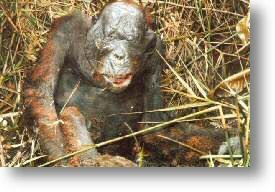
PALM OIL VICTIM "When we saw the big male approaching our camp we were afraid. So we quickly ran over to him and doused him with petrol and set him on fire.” Fermin, Bulldozer driver in clearance camp
 If you care to adopt an orang-utan out of around 600 living at the centre, here's the site: http://www.savetheorangutan.co.uk/diary/
More than ever, the actions of individuals are having collective and far-reaching repercussions. There has recently been a series on BBC 1 detailing the struggles of orang-utans in Borneo and the efforts of an organisation to save them. Documentaries such as these have followed a long line of programmes showing the life of the orang-utan within its own world but have sadly become less joyous as they are now intended to highlight, to us, the damage we have done through consumerism. ‘Orang-utan Diary’ now shows the struggle this species has to go through as a result of their homes being rooted up for palm oil plantations that are needed to satisfy western consumers’ demand for lifestyle enhancing products such as soap, Supernoodles and even some breads. As they attempt to survive through our greed, they are often killed for stealing from farmers’ crops, leaving young babies to fend for themselves. This story is all too common and orang-utan babies essentially end up in the centre, which cares and rescues them. Furthermore, orang-utans are naturally solitary beings with large territories over which they hunt for food but are now resigned to living with 600 of their kind who are still waiting to be released back into safer patches of land that will not be affected by milling and farming.
PALM OIL VICTIM "When we saw the big male approaching our camp we were afraid. So we quickly ran over to him and doused him with petrol and set him on fire.” Fermin, Bulldozer driver in clearance camp
 If you care to adopt an orang-utan out of around 600 living at the centre, here's the site: http://www.savetheorangutan.co.uk/diary/

ETHICS AND DUTY
’Happiness results from „obedience of duty“ ’ (1)
I am not entirely sure if I agree with this philosophy. Is the happiness I seek and encounter due to obedience? Is obedience referring to that towards social norms, laws, God, my conscience?... Surely one is unable to carry out the commands of all these categories at once . For what satisfies one, dissatisfies the other. But at what point do we stop to pause and follow our will, disobeying the demands of others? To what extent do we experiment.
Liberty is the condition in which an individual has the ability to act according to his or her own will (2) but there is a vague border between human freedom and human security. In 1941 the United States President Franklin D. Roosevelt famously proposed a set of goals, the ’Four Freedoms’, a set of articulated points as fundamental freedoms that humans „everywhere in the world“ ought to enjoy: (3)
1. Freedom of speech and expression
2. Freedom of religion
3. Freedom from want
4. Freedom from fear
Just how often do we see the opposite of these goals in action; either imposed upon a population or practiced by a ’maniac’ individual. It makes you wonder if humans possibly do demand leadership and a certain degree of enclosure by nature. Can society really live without a Big Brother to whom our obedience of duty makes us happy, who lays down the rules and regulations? Or does experiment, rebel, revolution and thought crime (4) excite and bribe our true happiness and social development.
(1) Immanuel Kant: The Metaphysical Elements of Ethics (1780)
(2)http://en.wikipedia.org/wiki/Freedom
(3)http://en.wikipedia.org/wiki/Four_freedoms
(4) George Orwell : Nineteen Eighty-Four
Freaks in nature

Following one of Sean Halls’ lectures earlier on in the year, we emerged with a thought, often debated, which put forward the suggestion that : ‘If humans are part of nature, anything we do is, therefore, natural.’ We as human beings declare ourselves as the dominant species of the world due to having the ability to develop and expand ourselves. We, therefore, set ourselves apart from nature. This in turn suggests that anything we do should also be considered as ‘apart from nature’ and treated as an intervention into nature

I remember having a conversation with a science teacher some years ago, who touched upon a theory which suggested that this unnaturalness is likely to continue, that our species is unlikely to evolve much, if any more then we already have; This being attributable to the fact that we do not adapt to our surroundings as most animals do, but instead, change our environments to suit us. For example, if it’s hot, we turn on the air conditioning. Likewise, if it’s cold we turn on a heater. In this way there is less opportunity for us, as a species, to engage in the process of evolution. With the slow destruction of our planet, it is highly likely that we will once again need to partake in the natural ritual, survival of the fittest, at which point, we may find ourselves obsolete.
If we cannot even participate in one of nature’s most natural process, the arguments suggesting that humans are not part of nature, therefore, define any of our actions within the natural world as artificial.
If we cannot even participate in one of nature’s most natural process, the arguments suggesting that humans are not part of nature, therefore, define any of our actions within the natural world as artificial.

With this view that human presence bringing a synthetic touch to the natural world, I wanted to consider 'Artificial Nature' in terms of the environments we create not only for ourselves, but for our animal companions.
Whilst we attempt, in many ways, to accomodate various animals who are endangered or kept as pets, we create backdrops for them to remind them of home. There is often an effort to make their enclosures and 'new homes' as close to how they would be in the wild. In addition to this, these artificial replicas are entirely for our own visual benefit on which we impose our own humanoid assuptions on. Despite our best efforts, these surroundings are, essentially, copycat environments which fall short of the natural beauty they should be enjoying without our interference.
Whilst we attempt, in many ways, to accomodate various animals who are endangered or kept as pets, we create backdrops for them to remind them of home. There is often an effort to make their enclosures and 'new homes' as close to how they would be in the wild. In addition to this, these artificial replicas are entirely for our own visual benefit on which we impose our own humanoid assuptions on. Despite our best efforts, these surroundings are, essentially, copycat environments which fall short of the natural beauty they should be enjoying without our interference.
This is a little home movie of my tortoise Tedward in the garden. As you can see, he wasn't particularly impressed by the tomato's involvment in his 'natural' habitat.
Infantilized Society

When I saw the video that Emily Hartern posted in the blog (Tuesday 10th March 2009, link http://www.youtube.com/watch?v=6Sb6RmRMbBY)
and even if the speech was written by an adult, a lot of what that girl was saying to a whole UN audience was what I felt when I was that age. Talking about the earth she says to them: If you can’t fix it, so stop breaking it. It sounded strange, a kid telling older people what to do with anger. We should definitely give the word to people that never have the chance to talk. Maybe for some reason they have been silenced. A friend of mine went traveling to the Amazons, I am not going to go into details, but he said he cried when going further and further just finding deforestation, forest depleted, invaded by machines, everywhere. Another friend told me the same, she found her way into a closed community separated by a stream. She liked it there, the locals received her and taught her about the place, she did not see ‘westerners’ for about six months until her father got worried and went to find her. It was a little community, I believe no more than 100 people she said, trying to keep the same traditions they had from before the colonization period. She said that they believe that western culture is an infantilized culture, that we live for our childish desires without respect of the environment.
Then coming back to Emily Hartern’s posted video, I see that maybe this community in the Amazons is right about our way of living, and that kids have to become adults because adults are ‘playing’ like children.
The Unperceived Power

As Designers we have the control to influence people. An industry based on the promotion of products, brands, corporations and the power to make the world overall a better place. A Designer must be aware of the social and cultural responsibility which their designs hold within the world. The impact of their designs must be recognised and the moral standard accounted for. Creating a general realisation that actions do in fact have consequences. The picture above is from the art exposition "L'art... Eb Eaux Troubles" [lit. translation: "Art in Troubled Waters"] in Paris. This picture demonstrates the link between design and the impact it could possibly have on people. Here we can see the influence of modern design being implicated upon a design used for a means of survival. Nigel Whiteley states "products introduced to aid a group's economic development have sometimes failed completely because they did not take full enough account of the cultural factors of tradition and identity."
Yes, I got excited with blog entries
I found the blog’s entries very interesting, particularly those who talk about personal experiences.
Let’s cite Hannah (blog entry 12th march 2009), she said: design “for the other 90%”… of course, I do not like the fact that “other” is a key word in this statement.
Again, if we talk about ‘the other’ we separate ourselves, as designers we should feel part of that we are going to design for. Then Hannah continues: The work I am doing in India now is only the result of the close relationships that I formed there (…)
the best thing I can do is just try to listen to what people tell me about their lives and their needs, and start from there.
I thought her entry was genuine, full of hope even if working within a slum is such a difficult terrain.


I remember going with my secondary school friends to a slum in Buenos Aires every weekend to give classes of mathematics and reading to kids without any access to schooling. By then I could imagine the realities of those areas. Being there was a different matter, it completely changed my views to talk with the people, to see how the pavement disappeared behind a portal made with wires in the middle of the city, into somehow another city, not far from my house, where we had to enter with a man that was part of a political party, there was no other way to get in to the place safely they said. We were probably used by that party to say they were doing something for the residents of the slum. However, no political party interested us, we were using them to get inside anyway. Of course the kids needed more than mathematics, reading and writing classes. Most of them were not accepted at school because of their home address, so they felt outsiders. They were so exited to share with us their places, their songs, somehow they could feel more integrated. We learned a lot there, I cannot describe how it changed my world, but I can say the impact of these relationships were very important. When Hannah says in the blog that the work she is doing is the result of close relationships she formed there, it makes me think that that is probably one of the best ways to design for society, to act locally and to learn from others.
Going back to previous years entries on the blog I found this entry (Ryan Mulchrone 12th march 2008): Our economic situation puts us in a position of responsibility for others but we must also learn to lose the superiority complex we have about poorer societies because we have just as much if not more to learn from them as they do from us.
Another entry says (Ruth 3rd march 2008): Perhaps it is time we took some of their practices and reflected them into our culture.
I think this is already happening, and hopefully in the exchange we will find better solutions.
I think the educational system should be one that allows us to move into different towns, countries and continents to help us with the process of understanding. Understanding goes way further when we have the opportunity to experience.
I believe governments have a great responsibility in education, citing Katka (blog entry 12 march 2007): When it comes to slums however, is it not also the politicians who become the designers? The ‘designers’ of peoples’ lives?
Film Manufactured Landscaped


http://www.edwardburtynsky.com/Introduction/Manufactured_Landscapes.html
http://www.youtube.com/watch?v=67j7JlEZzpQ
MANUFACTURED LANDSCAPES is a documentary on the work of artist Edward Burtynsky. Burtynsky large-scale photographs of “manufactured landscapes”—quarries, recycling yards, factories, mines and dams allow us to grasp the scale of the impact on the planet made by our type of industrial society.
Empower People
I come from a mainly agricultural country (Argentina, in the south of the Americas.) However, I did not realise it until I went to travel because I was raised in a big capital city, Buenos Aires. On my travels, mainly in the countryside and little towns in southern Latin America, I realised how the lives of other people were interconnected with mine, directly or indirectly, how I affected them and vice-versa. I also found how vast naturally developed spaces were affected by machines and human pollution. I came back to the city after about a year of traveling, to study at the local university there. I started with the feeling that I should thank infinitely all those people working in the countryside, transporting goods, working at the factories, constructing, writing and designing books, without forgetting other living species for giving raw materials and food to allow me and a small bunch to study whatever we wanted. It sounds as though a whole system is there to support us in doing what we are doing. I think the least we can do is to show respect. In the type of economy we live in we are all interconnected in a way.
Of course there is a responsibility if we do not want to make our clothes, grow our food, build our houses, kill the animals we eat, etc. and there are other people there doing these things for us. We have the opportunities not just because of our parents, but other people we may or not know. I would prefer to work hard for them, because they deserve it, we owe a retribution to them, them is us, the same with natural resources, without them there is no us, we are not separated, we are part of them.
It is interesting how we may perceive the world, citing Ben Barker (blog entry human/nature, 5th march 2009): In fact we know that we are gods, wielding the power of technology and bestowing pitiful benevolence on other inhabitants of Earth.
The problem then, our intelligence means we draw a line between us and everything else. We struggle to connect ourselves to nature. We are technology, retching forwards, morally confused and born into a world that is not ready for us. Is there a way to actually care about Earth, to connect to nature (beyond ourselves) and truly feel it, or would we just be kidding ourselves?
So if we are gods, then, gods have never been so confused. If we talk about pitiful benevolence and ask ourselves if we care about the earth, or it is really just about us, we could continue finding refuge in excuses and continue with the delusional.
I assent with Jane T (blog entry 21st March 2009): we are now ignorant to the influence that we have over our planets delicate structure and the consequences of our behaviour that will inevitably impact us. Insects are the stitches that hold together the very fabric of our planet.
The economic system has become so big and complicated that it is difficult to comprehend. It is easy to feel like we are little ants and that the best they can do is to follow the crowd. It is paradoxical because in the present time our society does not believe in crowds or groups, but in the individual. You have to be outstanding and unique, but follow the crowd. Advertising and media created the belief that this schizophrenic way is best for survival. In the mid time the rulers, the big companies, collide in their psychosis, seeking more profit, more power, they are also trying to survive. As I see it, big entrepreneurs and powerful companies have developed a psychotic economic system where there is no remorse for all the damage caused in the name of profit, and we, the followers, are replicating it. Nobody seems to care much about anybody else, so we can consume anything at all without guilt. If we feel guilt, we feel powerless anyway to do something. And so many entries in the blog confirm this.
Objects have the power to shape social imaginaries and engage sensations, we have a social responsibility and should feel empowered. How do we balance the cognitive conflict between individual vanity on the part of a designer and institutionalized pressures of the produced material world?
Put another way, designers are a product of the material society we all have constructed. If designs expose perceptions of reality, we are creating a cultural identity as well. If the future is being planned via certain institutions, are designers visualizing a future that has already happened? If this is the case we then have the hope and privileges of uncertainty.
It is important not to dismiss the power of our actions, and to empower people. By designing for people that 'nobody seems to care' (however this is not true), we are caring about them, making them relevant, giving them a voice.

DESIGN AND FUTURE : PLASTIC BAGS / LIVING WITH RUBBISH
Reaching a quantity of over one million bags being consumed per minute an estimated amount of 500 billion to 1 trillion plastic bags are consumed world wide each year. (1) British supermarket checkouts distribute about 10 billion plastic bags each year. It can take up to 2000 years for a plastic bag to break down and in London alone, 1.6 million of these bags end up in landfill sites unable to decompose, polluting our environment . (2)
Plastic bags break down by photodegrading, producing toxic waste contaminating soil and waterways and entering food webs when animals accidentally ingest.
Using the plastic bag as an example ,the desperate need of our population to steer itself towards a more environmental friendly society can be clearly outlined. Consumption, carelessness or rather ignorance is also portrayed. It is therefore inevitable, that our ethics change, that we as designers also shift towards more environmentally aware, sustainable and rational concepts. Arts and designs must be used to re orientate the views and habits of the public, to improve the relationship between science and society.
„ It is fundamentally a cultural problem that requires reorientating human development and the built environment; artists have an important role to play not only in creating new cultural contexts, but also changing the way that science is done“ (3)
„ Planet Organic“ supermarkets give us a taste of the direction towards which we need to filter our responsibilities. In November 2007, in thier refusal to use plastic bags ,they produced a bag made from GM free cornstarch which is entirely compostable and biodegradable, breaking down in only six months (2). Corn crop absorbs carbon dioxide from the atmosphere while it grows and then releases it as it breaks down preventing the excretion adn litter of toxic residues. This carbon neutral solution to the plastic carrier bag is evidence that with will power, science and art the crucial steps forward needed to change our style of living can be aided . Designing new sustainable products is drastic help to our future and above all a possible eye opener for society , addressing the heart of crucial issues.
(1) http://www.reusablebags.com/facts.php?id
(2) http://www.planetorganic.com/media_centre/press_releases/54_-ditch-the-plastic-planet-organic-pioneers-again
(3) Roger Malina. „Lovely Weather: Asking What the Arts Can Do fot the Sciences,“ in Ecomedia (Edith Russ Site ofr Media Art, 2007)
(4) picture: http://www.greencottonblog.com/category/plastic-bags/
How Ethical Are You?

Milton Glaser whom is best known for his I Love NY logo and his Bob Dylan poster created a questionnaire called Shown below is The road to Hell which demonstrates how ethics play upon our personal conscience when designing and creating products.
1 Designing a package to look bigger on the shelf.
2 Designing an ad for a slow, boring film to make it seem like a light hearted comedy.
3 Designing a crest for a new vineyard to suggest that it has been in business for a long time.
4 Designing a jacket for a book whose sexual content you find personally repellent.
5 Designing a medal using steel from the World Trade Center to be sold as a profit-making souvenir of September 11th.
6 Designing an advertising campaign for a company with a history of known discrimination in minority hiring.
7 Designing a package aimed at children for a cereal whose contents you know are low in nutritional value and high in sugar.
8 Designing a line of T-shirts for a manufacturer that employs child labour.
9 Designing a promotion for a diet product that you know doesn't work.
10 Designing an ad for a political candidate whose policies you believe would be harmful to the general public.
11 Designing a brochure for an SUV that flips over frequently in emergency conditions and is known to have killed 150 people.
12 Designing an ad for a product whose frequent use could result in the user's death.
These twelve steps show us how easy it can be to drop from step to step. Ranging from packaging to causing death. Nigel Whiteley says in his book Design for Society “’Design’ as a noun or verb was daily intoned – usually hopefully rather than purposefully – as a solution that was going to deliver us from all economic evils”. This demonstrates how we as designers must think of the values included within the work. As designers we think of the responsibility and how that responsibility can be diffused with the more people involved, creating a safety in numbers system. This system can be found within Stanley Milligrams shock generator experiment as well as raising a number of questions such as what ethical issues does the Milligram test expose? Are the test subjects behaving ethically? Is the experiment ethical?
Subscribe to:
Posts (Atom)