Wednesday, 12 March 2008

Remember the Future


"It’s a poor sort of memory that only works backward.”
- Lewis Carroll, Through the Looking Glass


The future has become more immediate than ever before in modern times. The future is no longer something distant, it’s not longer tomorrow, next week or next year. With the speed that the world moves at, the rate at which we create and consume and reproduce is exceeding expectation and predictions. Causality has been for a very long time, a subject of contemplation for humans, with Aristotle’s writings being the basis for many casual theories that came after, but it seems as though there is an increased general awareness of the effect of our actions. After all, we are being reminded of them everyday, in adverts, TV programmes, books. Ariel uses the ‘Turn to 30’ [1] slogan in conjunction with pictures of the ice caps, showing how turning to thirty is a way to help reduce global climate change. Persil advertise their ‘Small and Mighty’ [2] products as a way of reducing lorry loads, explaining it in pop-up book form with a child explaining the story. The advert ends with the words ‘Every child has the right to a nicer world.’ By using this technique, the advert brings home the message that we are all responsible for our world, and that we are not only destroying it for ourselves but for future generations; that in itself is a powerful message. Whether this is simply companies engaging in some green-washing is another matter entirely, but for now it serves to illustrate my point.

Design, by it’s very nature is future orientated. Designers employ, and become, trend forecasters, trying to work out what will be the next ‘trend’ in the future, the next fad that will require fulfilment. They make their trade from creating objects for the future, for future needs, envisioning the world in terms of ‘what if?’. Sometimes this comes in the form of objects, other times it is visions for whole cities, whole new worlds. Unfortunately sometimes the transition from idea to reality is not always a smooth one, things get lost along the way. After all, there can never be one ‘Utopia’ as humans, and the world we live in is so diverse. Instead a collective hetrotopia would be fitting, but maybe we should abandon great sweeping visions of a perfect world, and leave those to science fiction writers. Such visions have already been tried and mostly they have failed; the Le Corbusier inspired Pruitt Igoe being the most famous, with Ebenezer Howard’s Garden City theories resulting in Milton Keynes. Brilliant ideas in theory, but in the harsh light of reality these programmes become places of “corruption, rioting, poverty, crime, discrimination, despair and isolation.” [3] When considering the future, the past should always be taken into account.

It seems as though the little things, the little changes, such as re-designing packaging, using recyclable materials, providing ‘Bags for Life’ at supermarkets, concentrating fabric conditioning, while not exactly earth shattering in their conception, seem to be the more sustainable and successful forms of change.

References

[1] http://www.ariel.co.uk/energy_difference.html

[2] http://www.youtube.com/watch?v=pIISU0rnqVE

[3] Architecture for Huamnity. ed., 2006. Design Like You Give A Damn: Architectural Responses to Humanitarian Crises. Thames and Hudson

Bottles

“On average, every family in the UK consumes around 330 glass bottles and jars a year.” Bottles and jars are a type of packaging for liquid products. This type of packaging allows us to consume liquid products with a freshness seal cap, making it more convenient in daily life. However, what will happen to the bottles and jars when we finish consuming the drink?
When the bottles and jars have served their purpose it is highly it will become waste and rubbish. Designers have the ability to make to change this.


The Dutch beer company Heineken has made a change in their bottle packaging. Alfred Heineken visited a shanty part of Holland, and saw bottles littered all over the street creating an unhygienic and polluted environment. In order to solve this problem, Alfred Heineken then created a new packaging for Heineken beer and named it “world bottle”. This bottle is squared shape so it can be use as a brick after consumer has finished the beer. Firstly, the “world bottle” will not affect the quality of the packaging Heineken use for the beer and it also solves the shanty town problem by reducing pollution and making it more hygienic. This reusable bottle can be used as a brick, people can then collect the bottles and use them to build and have a more concrete place to live in.


Argentinians Mirta Fasci and Luis Pittau are two designers who have ideas similar to Alfred Heineken. They designed “Emium” which is a plastic bottle that can bond together like Lego. “Emium” can be filled with cement and used as bricks or to form other products like furniture.
Packaging design is now gradually becoming more sustainable as it has multiple uses, thus reducing the amount of waste created in this world.

Tuesday, 11 March 2008

Arts of Survival: The Elephant in the Room


‘One resident [of Kliptown], frustrated with the response from the West, said, “We need real care, not awareness. When one sees one’s friends and families suffering each day, one is aware of the problem. We don’t need pop stars giving concerts, we need doctors giving treatment.”


This quote is taken from the introduction of the book Design Like You Give A Damn, written by Cameron Sinclair. During his honeymoon in South Africa, he was confronted with the problems faced by the people of that country. He and his wife discovered that the biggest concern of the residents was in fact not water and housing, but health care and the AIDS pandemic. In my previous blog post I tried to point out the general apathy that now surrounds the issues of ethics and sustainability, a desensitisation to the struggles of others. By attending Live Aid, buying Fairtrade bananas, conscience’s are eased, but the core issues are left unresolved and pushed aside until someone else decides to pedal out the next series of appeals. By this, I am not trying to say that awareness is a bad thing, indeed, any action must be a good thing, the fact that people are now aware of the issues faced by people in developing countries can only be a good thing. But what makes it an even better thing, is if people start acting on this awareness, start getting actively involved Perhaps the problem is too huge to comprehend, and pushing it to the side, for another day is easier, whatever it is, designers play a massive part in bringing these issues to the forefront of the publics attention as well as providing practical solutions.


Projects that seek to help, such as One Laptop Per Child, while initiated with the greatest of intentions are not always successful, and often accused of being patronising or an attempt at imposing Western society and culture on others. So, what then is the solution? Is a patronising project better than doing nothing? Or are we simply attempting to do the wrong things, entering at the wrong levels? To deal with this, we would have to look at successful projects and ideas that really work such as Shigeru Ban’s Paper Log House, Nader Khalili’s ‘Super Abode’ and the ‘Q Drum’ which deals with problems of transportation. It seems as though a main point to pull from this is not to assume anything about the cultures being aided. Going in to areas the products are intended for, interacting and experiencing allows for a richer picture of the areas where design solutions are needed the most; an intersection of socio-cultural anthropology and design. As Cameron Sinclair found in South Africa, the biggest problems are often not the ones we in the West expect them to be.

References

1. Architecture for Huamnity. ed., 2006. Design Like You Give A Damn: Architectural Responses to Humanitarian Crises. Thames and Hudson

2. Design for the Other 90%

3. One Laptop Per Child

4. Image Reference - Banksy 'The Elephant in the Room'

Futures and Enlightment

Since the public realisation to climate change and over consumption ‘the benighted “science” of futurology has come back into style.’1 We live in times of uncertain futures as the rate of ‘predicted futures’ arising and then being discarded is relentless. ‘As if following a kind of Moore’s Law scaling principle, futures today seem to be reproducing themselves faster and more cheaply than ever. At the same time, their shelf lives appear to be getting shorter.’1 As I discussed in my first blog about climate change, it is difficult to determine what to believe to the point that now we accept the fast rate of changing opinions, due to media spin and attention, and approach most futures with scepticism. ‘From a formal point of view, future-nostalgia reminds us that the future is not, and has never been, an empty category. Even as we accept a skeptical critique of prophecy, we must acknowledge that for us the future is not so much underdetermined as overdetermined. Our lives are constructed around knowledges of the future that are as full (and flawed) as our knowledges of the past.’1 This has become the case since the time of Enlightenment which began with ‘the rise of modern science, culminated in the French Revolution and then dwindled in a wave after wave of yearning, hope and doubt. It was characterised by a scepticism towards authority, a respect for reason, an advocacy of individual freedom rather than divine command as the basis of moral and political order.’ 2

Design is concerned with the future in order to produce work that is consistent with the latest ‘future’ predictions and trends. Design and media also has influence on how these ‘futures’ are made. ‘In the arena of fiction, for example, the late eighteenth century saw an efflorescence of future fantasies. And for the first time in literary history, these futures took place not in some vague hereafter but in a chronological expanse freed from the finitude of sacred history, in the profane historical future, in the years 2440, 1850, 1900, and 7308.’1 In present day we as a society have become so used to the coming and going of different future predictions that we seem to loose all sense of urgency towards change and it therefore is necessary for designers to approach this communication project from different creative angles to re-create the sense of urgency and power of scientific authority, such as the Enlightenment movement, so changes can be made.

1 Histories of the Futures by Daniel Rosenberg and Susan Harding – Durham 2005

2Modern Culture by Roger Scruton – Continuum 2007

Image: www.mcphee.com/pixlarge/10476.jpg

Art Of Survival

When looking at shanty towns, many people in the western world feel the need to step in and 'westernize' those cultures. We want to 'help' the deprived people, but in many cases, we are merely patronizing them, as we want to impose our way of living onto them. But what do we even know about these people? Except for the obvious - their living conditions are very different to ours and they lack of many things we 'could not live without', such as electricity. However, you have to consider that these people are not necessarily unhappy with what they've got, as they have not been raised with our consumerist attitude and our constant desires for newer and better things.

But people living in townships and shanty towns have no choice but to use the little resources as they have, which usually are things that our consumerist society considers as trash, such as empty cans, or bottle caps for their arts and crafts. For years and years, selling their work at markets to tourists has been the main source of income for the uneducated people there. Foreigners love the simple yet beautiful pieces of design for their uniqueness and take home bags made out of Pepsi jars or bracelets made out of safety pins, pieces that you just couldn't buy at your local Primark. Things have changed significantly over the recent years, as many of the designs that surround us now were influenced and inspired by the work of the poor and began. Designers began using the same materials e.g. car tires or juice packets to make the creativity blossoming in an underprivileged culture more accessible to western world. I'm amazed by the fact that the people who have nothing at all are able to teach us- the people who have everything- a lesson or two how the materials we just chuck away, could be re-used and have a second life as a piece of art or design.
"In many areas designers must learn how to redesign. In this way, we may yet have survival through design." Victor Papanek, Design For The Real World


Image Source: http://www.globalcraftsb2b.co.uk/images/safetypinbrace.jpg

Artificial Natural

Eduardo Kac may consider her a piece of art, but to me, Alba is rather an example of the abuse of science and modern technology. To be honest, I really don't understand the desire to add genetic material from jellyfish to a rabbit embryo just to make it glow for sake of art. "He describes this as 'a new kind of art' that will cure us of from needing to "paint as we painted in the caves'"1


Looking at pictures of poor Alba was nothing but disturbing to me. We might live in world where almost anything is possible in science, yet I don't think we should overuse our power and interfere in nature like that. It's amazing that we can push the boundaries far enough to create something as bizarre as Alba, but really, there is a reason why rabbits don't glow in the first place and people should not try to change that. Especially not, if this genetic experiment is to no one's benefit.

Maybe I would have a slightly different opinion on that matter if alternating Alba's genes would have helped to find a cure for cancer, but as Kac has stressed, she was merely created to be showcased in an exhibition. Which quite frankly, I find really sick, as there are a million other ways to express yourself in art without messing up mammals. We might consider us superior to the animals because we can talk and think and are not just guided by our instincts, but I don't think that should give people the right to play around with genetics as they please, just because they can.

After all, who knows what could be next? Glowing babies?

sources: http://george.loper.org/trends/2000/Oct/78.html
1 - Dale Hoyt: http://www.stretcher.org/archives/r9_a/kac_dh.php
image from: http://george.loper.org/trends/2000/Oct/neonrabbit.jpg

Artificial Nature.

After thousands of years of teaching ourselves how to cultivate crops and rear live stock we are now looking towards technology and creating synthetic environments and modifying our crops. However, due to high demand is quality being sacrificed for quantity? Battery farming of chickens for example, although widely disputed, is widely practiced, demonstrates an increase in quantity relation to a decrease in the quality of living for the animal. Looking at the ‘Pig city’ from the lecture is it, although sustainable, ethical. Is the wellbeing of the animal compromised by the artificial surroundings of the ‘city’? By man deciding it is our right to dictate how other beings should live are we creating another battery hen situation or is it really an ideal substitute to valuable space, or are we creating a global solution to a local problem. Despite being a trend today, buying local produce and maintaining a low food mileage is sustainable and, as long as the animal is raised in its natural environment, it is ethical.

            Consumerism today is starting to drive most forms of cultivation. Agriculture in particular is becoming a playground for technology creating artificial environments for animals and genetic modification for crops may enhance production but the ethics are questionable, as well as overturning millennia of the evolution of crops and agriculture the soul has been lost from the harvesting process.

            However today as we are made more publicly aware of this it seems we are starting to revert to more traditional methods of farming although it may be a trend in some cases, but the consumers are demanding more organic, free range and local produce suggesting the pendulum is starting to swing back the other way towards more classical methods of farming.

Futures

Free Topic: P.E.S.T. in Ethics of Preservation, Development or Interaction


When we think about sustainability, how much should we “preserve” existing environment? In Expo 2005 Aichi, themed “Nature’s Wisdom”, controversial matter occurred between “preservation” and “development” and there was the affair that almost all of their first members of designers and architects resigned from the project in a way. The centre of controversy was an “undeveloped” forest planned as the site. While local community, their government and mass-media stood on “preservation” of the forest, designers and architects kept to propose to “use” the forest. At last, their argument has never met through cycle of discussions and their master plan was severely changed. It is a case-example of design related to politics, economy, society, technology, media, ethics and sustainability.

The initial plan was “in” the forest. “regarding the forest itself as “living exhibition resource” without trucking in great numbers and massive volumes of exhibits from outside the forest”. “And technology, far from being a concept opposed to nature, should have been repositioned as a continuation of nature’s elegance.” Visitors wearing wearable computer would interact with the elements of the forest and acquire information about them, for example “experience the forest with the eyes of a bird or an insect” or on the level of micro-organisms of genes by the latest technology. With Head Mount Display, they can enjoy a virtual opera in the forest. There would be not any big constructions but the forest as living digital archive by minimum installation of devises.

However, to mass, “undeveloped forest” was holy place anyway and untouchable area without any logical reasons. Actually, a nest of rare birds was discovered in the forest and it was crucial to change the master plan. The new plan, the final plan, was basically a conventional type of Exposition. Because of “preservation”, a park “outside” the forest was developed and a number of “pavilions, gigantic-scale image projection, a mega-scale Ferris wheel” were built for presentations of the latest eco-technologies. This Exposition was success as public works and relatively eco-friendly. However, which plan would work better as the Exposition for pointing out future in the concept of “coexistence” of nature, technology and human? "There are not problems that can be easily solved here."

This example is questioning what “preservation” should be and where the “resource / material” should come from. Moreover, it will be some hint for discussions in the lecture of “The Arts of Survival” about Portable Light, which brings different lifestyle into another culture. When we want to introduce something new properly, it should not be “stuck on” but be “melted into” existing environment. If we really want to preserve something precious, we should go inside of its “forest” and analyse what there are, not just fence it off from outside. We need “interaction” rather than “preservation” for sustainability.

Hara, Kenya. Designing Design. p.330-355. (Baden: Lar Muller Publishers, 2007)
“A record of Kengo Kuma’s lecture in Academyhills”
http://www.academyhills.com/gijiroku/kumagai/25.html (accessed on 10 Mar. 2007)
Image: Image:
GA. Kuma Kengo 2. p.6 (Tokyo: ADA EDITA, 2004)
"expo 2005 photo esseys" <
http://www.antonraubenweiss.com/expo/photos8.html> (accessed on 10 Mar. 2007)

Monday, 10 March 2008

Futures


The very notion of sustainability is the preservation of the present for the future. The 1987 brutland report depicts ‘sustainable development’ as “development that meets the needs of the present without compromising the ability of future generations to meet their own”. Looking at sustainability on a region scale has inspired many architects such as Le Courbusier and Ebenezer Howard. Designers, sociologists, geographers, topographers and architects etc must make certain assumptions or projected predictions about the future in order to provide for it. Le Courbusier demonstrated such a prediction in 1929 when he exposed the villa Savoye. A significant feature of it was that it contained a garage within its geometrical and cartesian structure. In 1927 only 28 percent of the country owned an automobile thus making the Savoye a confident proposal for the way in which we should live in the future. Courbusier embraced the growth of the car and successfully paralleled his design work with the trend.
Courbusier probably realised the unsustainable nature of the vehicle but with his designs for the radiant city (1930-1935) attempted a balance with large amounts of green space etc. The difficulty with sustainable design is due to the uncertainty of the future. In an technologically advancing society it is difficult to predict future demands for living environments. As a result we can see many examples from the past of failed ‘future designs’. Many modernist utopian ideals for example demonstrate how one persons prediction for a utilitarian future are unable to stand the test of time. The Pruitt-Igoe, housing project built in missouri (1951-1972) is a good example of such naive design. Kate Stohr states in response to such developments that “Slums have not been replaced by ‘new towns’ or ‘Radiant cities’ but by ‘vertical ghettos’.”
The methods and processes by which designers base future proposals must therefore be questioned in order not to repeat mistakes of the past. But in an ever increasingly environmentally concerned society we must aim to create a balance between “social, ecological and economic realms” and revert to a society that aims to clear our ecological debt.

Arts of Survival

Almost 40 years ago, Victor Papanek claimed "that which we throw away, we fail to value." (Papanek 1971) Having rather obsolescent consumption habits may only be natural to people living in the developed world. In the developing world however, most people have not had the 'opportunity' to be obsolescent. It is within these circumstances that one can ascertain the real material value of an object. In 'Design for the Real World' Papanek demonstrates how people from less prosperous regions of the world learn to fully exploit the materiality of an object. He came across a cooking stove design made from used license plates in Mexico, sold for 8 cents. A family usually used this stove for 10 to 15 years, before its soldering would disintegrate. Only if the broken license-plate-stove would be completely irreparable, would the family afford to buy a new stove.

The intention of this example is not to glorify the creativity of slum dwellers. To the contrary, it serves as an indication of the terrible living conditions of the majority of this world's population. Body Shop founder and human activitst Anita Roddick has stated: "(...) a short walk through the outer estates of many of the greates cities (...) betrays the hideous ugliness that we expect large groups of the world's population to live in. Often it is ugliness, that has been deliberately designed as a concrete monstrosity, using regeneration money that remains an unpaid debt long after the new batilles have crumbled away." (Simms & Smith 2008) This elloquent opinion inspires me to think that, perhaps, designers need to start designing things that are more durable, because "that which we throw away, we fail to value." (Papanek 1971)

Papanek, V. 1971. Design For The Real World. Great Britain: Paladin.
Simms, A. and Smith, J. 2008. Do Good Lives Have To Cost The Earth? London: Constable

Futures

Should design be a luxury or a necessity?

In the “Futures” lecture I picked up a quote, from Kate Stohr out of the book “Design Like you Give a Damn” (London: Thames and Hudson, 2006), page 34, which I like to discuss further.
The passage reads as follows: “This disconnect would eventually lead to a crisis of faith: What role should design play in providing basic shelter? How could architects best address the needs of the displaced and disenfranchised? And, at the heart of these questions: Should design be considered a luxury or a necessity?”
What I find the most interesting part is the question should design be a luxury or a necessity?
So is design a “fairy dust sprinkled on products”, a lifestyle we live or something much more important. Although please do not understand me wrongly, I think that fairy dust on a product is very important.
But should we not make intelligent use of design, should not that be the aim of a good designer. Should not form follow function?
I think design is not a luxury. Design is a tool, a tool to make sense of an object, make it practicable and not over-complicate it. In that sense I believe designers should approach design. Therefore do not only design for the 20 percent of the world population, which is considered as wealthy, but for the 80 percent, which live in poverty. I think, that in the future designers should aim to achieve so.
Design is not a luxury because design makes objects usable and only if it is designed it will achieve to fulfill its use in the best possible way.
The role of design in providing basic shelter is to make it practicable, cheap, useful, clever, adoptable, flexible, better and reliable. No architect can achieve so without the help of a designer.

Esse est percipi – “Design counts”.

'ASIMO' (artificial natural)


Honda has developed a humanoid robot named 'ASIMO'. The machine is created to serve its human counterpart, supported by the built-in intelligence, which enables it to multi-task for an approximate 25 minutes. At the current stage, ASIMO can read facial expressions and human body language of its human subject. That's not all this light weight (magnesium alloy) robot can muster. It has the ability to: run at 6km/h in straight or circular sets, push a cart at a set speed, going from straight to sharp bends in fluent form, the agility to carry and hold objects, that weigh around 2kg or less, climb stairs or descend from long stairwells with ease, by measuring each step without any mistakes (ideal for office assistance).

The ASIMO with all its human qualities, ranging from: greeting oncoming people, follow them, move in the direction a person indicates, recognises a face for future reference, has a built network that is connected to the internet, which provides information on demand. When totally independent, without 'assistance', ASIMO can adjust to situations, when placed in an environment, alien to office building settings. Its machine qualities are governed by precision, picking upon spatial flow, and mapping locations with high-tech cameras. When moving from A to B, it calculates the distance of location from memory, and executes with precision. 

It has taken the research team, three decades to assemble the 'original' concept. The vision could not be realized back then, due to 'slow' technological advancements. Robots are made to deliver service to humans, each model shipped to meet standards. It has opened up a market for robotic commodities. Extensive studies are carried out to formulate, how a humanoid robot can coexist amongst humans, and how it would contribute to society at large. "It's likely the robots will become the most valued commodity, in centuries to come."

http://world.honda.com/ASIMO/

CONTACTED TRIBES

With our practices we created a kinky fractal structure. With giddy and superficial pace we developed an extreme 'imperative' scope. For many years we focused on physical reality and physical world that is. We raised topics that caught people's attention which got 'them interested in some of the more remarkable aspects of the physical world and various speculative matters.' (Penrose, 1994) And, we still don't know the answer to our real motive.

We industrialized almost everything that surrounds us, that binds us. We have designed 'behind the closed window', and we have sculpted 'the giant monster' so inevitable that only a pinch of tribes remain non-contacted. It is only a matter of time when logging industry will forced them to leave their homes and left them obliged to be dependent on drugs when sick.
Our fruitless killing without depending on survival is much of our everyday life. 'All life depends on death', but not on needless counts. We create shelters and provide other humanitarian design solutions in order to redeem the problem that we created in the first place. This is neither the first nor the last 'flew over the cuckoo's nest', and we still can't put reasons on it to exculpate the accused. ARTIFICIAL.

<
Hurricane Katrina lumbered ashore in 2005 with punishing winds and torrential rain, made Florida handicap. The United States, the largest producer of greenhouse gas emissions, should bear the responsibility for the disaster.

>
'The struggle between what could be called the Uncreated and the Creation - illustrated by the permanent contradiction between man and his taboo. Everyday love and the capitalism way of life. Cannibalism. Absorption of the sacred enemy. That he may be transformed into a totem. The human adventure ...' (Andrade, 1930)

<
Cannibalism is occasionally still carried out by the Kombai people of West Papua, now Irian Jaya.

In our adventure, we would even investigate exceptional cannibalism as a homicide and shut our eyes before genocide. We are looking ahead engaging with intolerance towards cannibalism, that only appears to be a form of tribal punishment, executed by a member of the family that lost a man. And only then, when a fiend male is a killer, and that is practicing witchcraft. Male Witches are believed to be eating the souls of their victims, and their brain and the stomach, where the souls lies, must be eaten in return to free the soul and end the terror. NATURAL.

>
'... The earthly end, only the pure elites, however, where able to realise carnal cannibalism, which contains the highest meaning of life and avoids all of the catechistic evils identified by Freud. What takes place is not a sublimation of sexual instinct. It is the thermometric scale of the cannibal instinct. From carnal, it becomes elective and creates friendship. Affectionate, Love. Speculative, Science. It turns away and transfers itself. We approach vilification. Low cannibalism joined with the sins of the catechism - envy, usury, calumny, murder. It is against this plague of so-called cultured and Christian peoples that we act. Cannibalism.' (Andrade, 1930)

Even though, we are 'moral beings capable of acting from a reasoned set of rules', and these rules are defined as 'ethics', we contradict and trick ourselves - our senses lead us astray. We all are contacted by 'the giant monster'. And now, we are here to go and find other tribes that remain non-contacted, but not for long, no longer then ten years, give or take a couple.

Survival - It's up to you


The problem inherent in designing for “the other 90%” lies in the fact that this 90% does not represent 90% of a viable global market; the other 10% have most of the world’s wealth, and unfortunately money makes the world go round. To design for the Third World could sacrifice a design firm’s profitability for its reputation, and possibly put the country into even more debt (perversely, probably to the design’s country of origin) if an item sells well there.

Regardless, for a country to improve its standards of living the whole nation needs to contribute, receiving outside aid only makes the situation more bearable in the short term -

“as UN researchers emphasise, ‘there is little or no planning to accommodate these people or provide them with services.’” Mike Davis, Planet of Slums, Verso 2006.

Couple that with the difficulty of a First World firm designing for such a culturally different and diverse population, it’s an almost overwhelming proposition. Campaigning and literature has made many acknowledge the difference in quality of life in the Third World, but only an intrepid few make the tentative step towards attempting to help.

I believe it is up to the designers themselves to decide whether it is viable to design for “the other 90%”. Of course it makes moral sense to do so, however it depends on whether it is an economically viable option and not just a satisfying deed. After all, everyone in a First World country needs to earn an income to survive, themselves.

Image from : http://www.marxist.com/Globalisation/third_world_debt.htm

The Arts of Survival- Survival by Design?

So many times we hear of survival of the fittest and all that goes along with Darwinism, but what truth is there behind this, for the past centuries of human existence? Yes, evolution has played a major role in the sustaining vitality of the human race, but what about now? Have we reached the end of our evolutionary cycles? Do we no longer need to adapt to our surroundings with our ever expanding need to design our personal means of survival?

We are the only species to really change our environment to better suit our needs rather than us change to fit our surroundings. This seems to be our approach to many things. Instead of finding a means of compromise and letting ourselves naturally adapt we immediately come up with some way to change our surroundings so we do not need to do the changing. An extreme example of this is living in a semi toxic environment where breathing and sustainability would be quite hard. We come up with shelters, gas masks, air purifiers etc. All products of design to help us maintain healthy living environments. Clearly, it would be hazardous to continue living through these circumstances but there is no way for us to naturally adapt or evolve to be able to survive these situations. We are not exposed to small doses with enough time for our bodies to naturally change and sustain. Organisms breathing oxygen for the first time, a once toxic environment, evolution and adaptation had to occur along the way on some level or the transition from water to land would have never occurred. How much of a natural adaptation process has the human race accomplished most recently?

It appears that we no longer have the need to change ourselves. We implement design to help change our surroundings to better suit our needs rather than any other sort of personal developments we could make naturally. Without design it is hard to say if the human race would even continue to be in existence. Without design we certainly would be in a different sort of evolutionary state. Design is essential to our immediate survival, but at the same time the question stands, is design hindering our evolutionary advancements?


Arts of survival

Investment, Design and Education in rural Places to stop poverty and migration into cities.

  • "In 1950 there were 86 cities in the world with a population over one million; today there are 400, and by 2015, there will be at least 550.1.

  • Cities, indeed, have absorbed nearly two-thirds of the globalpopulation explosion since 1950 and are currently growing by a million babies and migrants each week.

  • 1.2 billion people are living on less than a dollar a day.

  • There may be more than quarter of a million slums on earth and in 2001 it wasestimated that there were at least 921 million slum-dwellers." (Mike Davis, Planet of Slums)

What can be done to stop poor people from migrating into cities and in many cases into a bigger dilemma?

Banking on the poor and "friends of rural Women"

In the late 70s in Bangladesh, Muhammed Yunus (Nobel Peace Price Winner) and the Grameem Bank started as the first to give out micro-credits to poor rural women. Mainly Women are chosen as they are more likely than men in repaying loans and divide their earnings over the whole family.
The idea is that small loans with low interest can make a big difference in poor peoples lifes.
Micro credits in rural Communities give opportunities to many people that otherwise would have left to cities; It has been observed that the villages receiveing micro-fundings have not only less emigration but as well a lot of people returning from the cities.

Yanus believes that this system can make an end to poverty in the whole world. At July 2007 Grameen Bank has issued US$ 6.38 billion to 7.4 million borrowers and by the time hundreds of other micro-financing Institutions have rosen.
http://www.youtube.com/watch?v=WfdD3NPgEY4&feature=related
http://www.youtube.com/watch?v=MrUQKuvsmvw&feature=related

Not only financially can be helped; Education and Design concepts can help in poor community's as well as money.
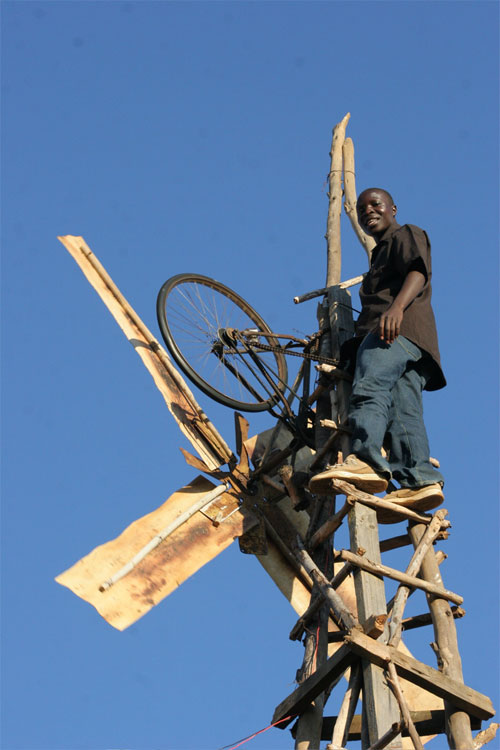
With 14 Years William Kamkwamba from Malawi, has build a windmill out of scrap after having seen a picture in the book called "Using Energy" in a library close to his village.
The Windmill powers three pulbs and 2 radios. William is now 19 and looks for funding for his big dream of going back to school and building a bigger windmill that provides power for the whole community.
http://www.ted.com/index.php/talks/view/id/153

Opportunity is something that millions of poor people are fighting for; they illegally cross boarders, risk their lives and then find themselves in an other miserable slum of an other overpopulated and polluted city, dreaming of their villages and families they have left behind.
In order to stop this vicious circle we should start at the very bottom and invest and design for the rural people.

Virtual identity (futures)


Design has its value, to broaden man's vision for the future, even if the future can't be realized in the realm of  'existing space'. A 'New world' had been created from the literary movement, inspired by Neal Stephensons novel 'Snow Crash'. It was to be known as Linden labs, the directors of
Second life, virtual worlds.


Second life's popularity gained '9.8 million' registered accounts in 5 years, prior to its launch in 2003. The residents could represent themselves in a wide variety of humanoid or other forms, taking physical and customizing them to a change in appearance, either as male or female avatars. The freedom of wandering around, talking to other avatars, building homes, visiting clubs and spending linden dollars on virtual commodity, seems life deserves another usage, in the from of  'virtual identity'. Since the environment is expanding and more people are adopting to the idea of living a virtual life, satisfied by the need to be accepted in a world excluding 'traditional values' and 'religion'. A world without physical engagement and only 'information' dominates future development. Where does such a world and information reside? 'It is home to the Internet, and everything it holds in its domain.'

http://www.secondlife.com

Sunday, 9 March 2008

The Arts of Survival - What constitutes a living?

If we consider consumption as we consider a food chain, we may understand that products we recycle everyday and consider in ‘old’ terms “near the end of their life-span” and in ‘new’ terms “at changing point in their lifecycle” may be understood very different to people living and working in the heart of slums across the world.

Trying to understand arts of survival Dhavari a central slum-city of Mumbai is a good place to take a closer look. An Indian (but American trained) architect Mukesh Mehta, has accomplished to get the official stamp to carry out his urban plan for this slum area. The ‘problem’ being that Dhavari has grown for over 3 generations and Mumbai has now expanded so far out that it is surrounding the slum, making Dhavari the physical city-center. It is clear that the response to the plan within Dhavari is varied and mainly negative. A debate site www.dhavari.org expresses a few opinions.

We may try to solve the problems with the best intentions and sometimes with necessity but how do we consider the soul of the lives of people we intend to help in the process.

A big issue is that the main industry of Dhavari, as in so many other slum cities, are recycling-factories and pottery, both very polluting. In the case of Dhavari both types of industry is no longer feasible to have in the center of as large a city as Mumbai, the smoke from the potteries are so bad that it affects nearby hospitals. Any polluting industries are banned in the new plan. These industries will have to move outside the city. Having found a way to make something new from scrap and build a house and a life from not much, the concern of the ‘slum-dwellers’ is logical. It doesn’t take much imagination to think that if this ‘urbanization’ is carried out merely with good intentions but without great caution, it could end up forcing the inhabitants of Dhavari to the new edge of Mumbai to start all over again.


Tate Modern ‘Global Cities’ Exhibition Folder

http://www.economist.com/world/asia/displaystory.cfm?story_id=10311257

Image from above Economist article

http://ngm.nationalgeographic.com/ngm/0705/feature3/index.html?fs=seabed.nationalgeographic.com

http://www.dharavi.org/


Is it natural to surround ourselves in the natural?

My last blog showed how Heather Barnett used biological imagery to form repeat patterns for use on wallpaper. The use of microbiological imagery was interesting as it was unique, but it made me realise the extent to which natural imagery surrounds us; we have plants in our homes, and we give flowers as gestures of affection. We are surrounded by floral patterned textiles and wallpapers, and wood grain exposed in our floors and furniture. Flicking through this month’s Elle decoration demonstrates that being surrounded by the ‘natural’ seems natural.


My Bed - Now thats 'Natural'!


We are encouraged to eat naturally, to sleep naturally, and to encourage natural light into our living and working spaces. We are now being sold energy packages as ‘green’. It seems the ‘laws’ of nature play a bigger part in our lives than we realise. ‘Going Green’ is clearly a currently sexy issue, so to what extent is this natural? And to what extent is the ‘natural’ a cultural construct? Or nature’s dictatorship?


In Future Natural George Robertson et al. discuss the term Futurenatural.
“The construction and reproduction of ‘nature’, the ways that this ‘nature’ is then instrumental in defining what is or is not natural, and how formulations of ‘what is natural’ eventually attain the status of convention that present ‘nature’ and ‘the natural’ as seemingly unproblematic.” (1:1996)
Robertson et al. suggest nature is a cultural construct formed over years and years of human intervention into our environment. Suggesting our ideas of ‘nature’ are highly constructed and manipulated.
“’nature’ is like all concepts, a product of discourse” (1:1996)

Ester Kneen

Robertson, G et al. (1996) Future Natural. London: Routledge
Elle Decoration. March 2008