The Government with its enviro-agenda, it seems to be neglecting one thing. The majority of us middle or low-income earners would like to ‘go green’ but it is just too expensive. I would love to have a wind turbine and solar panels generating household electricity but it would take me decades to recoup the initial investment.
Another example: nearly 200,000 Band G high-emission vehicles entered our road network last year. Why dose not the Government limit the number sold per year from the most polluting bands to 30,000? The prices would increase as supply would be less than demand and anyone willing to pay the premium to own one of the 30,000 should also be able to easily afford the congestion charges, oil, fuel and parking fees that these big and powerful organizations would attract.
In Wednesdays ‘Metro’ I have read that ‘Nasa is too skint to save us! The cost of finding all the asteroids that might hit Earth is too high to do anything about it’. Nasa says. Tracking at least 90 per cent of the 20,000 potentially ‘killer’ asteroids and comets by 2020 would cost about £519million. One of the solutions would be to build a new ground telescope solely with other ‘helpers’ telescopes for a total of £415million. Another option would be to launch ‘a space infrared telescope’ which is faster for £500million. After this proposal Nasa and White House officials have made their statement: ‘The decision of the agency is we just can’t do anything about it right now’. As if they have any other, more interesting things to do, than protecting millions of people on this planet from complete disaster!
My question: Is it all worth it? Does the recycling ‘things’, energy savings, green pollutions and all the rest of helping the climate change issues are going to change anything?
My opinion is: At the end of the day, the history like to repeat it self, so the world is going to the end and no matter how hard we will try to stop it, planet earth needs to reborn. We still have enough time to find another liveable planet and prepare it for our grandchildren to come.
bibligraphy: tv news, Metro, people
Wednesday, 14 March 2007

Of squirrels and potatos.

One example: the potato spread originally from the
The tomato is also originally from
Although nobody would consider the potato or the tomato as “exotic” vegetables they once were unknown in the rest of the world.
This artificiality does not only apply to food. Animals were also introduced to other continents, for example the Sciurus carolinensis, better known as the gray squirrel, which nearly extinguished the European (red) squirrel in the
I do not need to mention the sensitive ecologic balance of the Australian Continent that is even parodied in the Simpsons…
The range of examples is endless and naturalness and reality are always relative and shifting.
Who can say that, for instance, Second Life, the famous social network website is not real? Who can postulate that our daily life is not virtual or artificial?
The meaning of the terms “artificial/ natural” therefore lie in the eye of the beholder. There is not a binary choice between these two terms like “right/wrong” or “black/white”. There is rather a bandwidth or artificialness and naturalness.
Just the designer

I would like to pick up on the point Lena makes about becoming desensitised to danger through the existence and abundance of panic buttons. I agree that through the mass media’s constant bombardment of panic buttons we no longer “recognise the alarm as a sign of potential danger.” Have you ever run over to a car that’s alarm is sounding to check everything is all right? The reason we don’t react is not that we don’t care that someone’s car is being broken into but because we’re so familiar with hearing it, we’re almost certain it’s just another case of someone not knowing how to unlock their car.
The barrage of information condemning every choice I make has lead to the point where sometimes I wonder if I care at all. It makes it incredibly hard to make any decision without feeling like your about to be blamed for all the wrongs in the world. I sometimes have to actively remind myself that these things are real and that I do care about them and I should be more active. But because we feel so far removed through the technologies we posses it makes it hard to feel we can play any effective role. Panic buttons have put us into a state of risk unreality where we feel lost to do anything, and then their real purpose emerges. Not to warn us of the dangers we face but to keep us in a state of control, of helpless obedience. But it’s less than obedience because that would suggest we are actually doing something, instead it is more like a state of coma. Panic Buttons exist to keep us from opening our eyes and changing the way things are.
With so many headlines and information floating around it’s no wonder we feel lost to do anything because we don’t know who’s telling us the truth anymore. When even climate change’s credibility comes under attack through The Great Climate Change Swindle and our assured fatal end to humanity is questioned, what are we to believe?
As designers how should we react when a client asks us to communicate a controversial message to the public? Is it our job to question the client and debate the credibility of the information? Seems a little out of our league when the experts cannot even get to the bottom of it. I feel I have felt this to a small extent in our Live Project for Lewisham Council. In the original briefing I was shocked to hear our client tell us “that we’re not arguing whether it’s happening, that’s a given” And that it was our job now to “convince other that it’s happening.” I think my Goldsmiths alarm bell went off when I heard this. Having been constantly told to question everything we were now being actively told not to, to believe it and make others believe it too. I expect this is a likely picture of the way the real world works. So we get on with the project regardless of personal beliefs because after all, we’re just the designer?
The Risk Society and Beyond: edited by Barbara Adam, Ulrich Beck and Joost Van Loon, 2000, SAGE Publications.
The Great Climate Change Swindle: Martin Durkin, 2007, Channel 4.
www.news.independent.co.uk
Tuesday, 13 March 2007
Slum it or Lump it?
 For the first time the urban world would over populate the earth, this rise of the urban society will increase the already large gap between the urban life and the city life. Slums are defined as impulsive settlements on the city margins that started to show up during the first years of the accelerated urbanization process, that were manifested as groups of shacks or provisional housing.
“The total number of slum-dwellers in the world increased by about 36 per cent during the 1990s and in the next 30 years, the global number of slum-dwellers will increase to about two billion if no concerted action to address the challenge of slums is taken.” (Tann vom Hove, City Mayors)
Many people who live in slums have aspirations of leaving the slum life and living a “happier” western life. This is one reason for the high rise in immigration. Maybe if this idealisation was changed, people in third world countries would prefer to make their lives better in the space that they have, rather than leaving it to be lost in a western town that does not live up to their aspirations.
 I was born in Nigeria, which is apart of the third world area. I moved to the UK when I was six and still have a vague memory as to what it was like back home. I remember the village slums and the high buildings in the cities. Looking back I have been asking myself, is it the job of the people who live in the third world to help themselves? As they can build skyscrapers in the cities, why then can they not take care of the villages as well? As harsh as that idea may be, the possibility is there. If people in such situations were to design for their own, maybe the designs would become more relevant and would therefore take shape more. The above picture is of a development taking place in Nigeria, which I took part of on holiday. Another example is the slums in Bogotá, near Brazil. In 2001 urban improvement policies for Bogotá, including governmental reforms for greater efficiency began to take place.
“During the past few years, remarkably effective actions involving urban regeneration and recuperation have been conducted in the central areas. New legal instruments and tools paved the way for reforms and political transformations at the local level and improved the quality of life for many population segments.” (UN-Habitat,Global Report on Human Settlements 2003)
The government of Bogotá decided they needed to make a change to the living of their people, therefore they changed their law to improve slum life. So what can designers do? I hear you ask, well I believe not much. Designers could go as far as designing a way to improve living, but they can not bring a person out of poverty. That is the job of the government and the people themselves. The best designers for the situation such of slum living is those who live in slums, and have experienced the life. Thus it is more of a slum it or lump it situation. Designers should not stop trying to make a difference, but they should encourage those they are trying to help, to also help themselves.
Bibliography
http://www.citymayors.com/report/slums.html#anchor-some-47857
http://www.ucl.ac.uk/dpu-projects/Global_Report/cities/bogota.htm
Whiteley, Nigel. Design for society (London: Reaktion, 1993)
The panic button lecture talked of designs that prepare for risk. I think it would be interesting to talk about recently proposed safety gear. Reading other blogs on this topic I don’t believe this area has been discussed in much depth. When thinking of risk I think of some form of protection that acts as a deterrent. Ulrich Beck proclaims that “The essence of risk is not that it is happening, but that it might be happening”.
Safety; “like love, it is a universal feeling and, as such, has inspired endless analytical thinking and motivated science, literature, religion and art. On our sleeves we not only wear our hearts but also big red panic buttons” (Safe, design takes on risk, Paola Antonelli). Do we necessarily need an object to condone our panic? This is an appealing subject I thought about whilst reading Lena’s blog (06 March 2007) “How would pushing this panic button assist me in remaining calm and to act accordingly in a given situation?” Beck argues that “risks are manufactured, not only through the application of technologies, but also in the making of sense and by the technological sensibility of potential harm, danger or threat”. In some cases he is right but this gear can “deal with self-preservation. Created to protect body and mind from dangerous or stressful situations convey information, promote awareness, and provide a sense of comfort and security”.

Fig. 1
Helmets prepare us for risk, in case we fall off our bikes we are more likely to survive by wearing one. “Protective garments of accessories, however, rely mainly on materials that allow them to perform as thicker skins or outer shells of the human body”. There are advance types of protection such as the design ‘Suited for subversion’ (Fig. 1) “A civil-disobedience suit to be worn by street protesters to protect themselves from police batons”. As a designer I am often thinking about how to prepare for a mugging. Often I carry a deodorant spray, other than a rape alarm. The only concern is that the objects can be used against you. Fascinatingly the ‘Design against crime’ (Fig. 2) company produced some bags made of material consisting of electronic and durable textile material (Cordura) “resistant to abrasion” and a built in “anti attack alarm” to scare off the criminal. “The philosophy of this design initiative is that the best protection against crime is awareness and willingness to take some basic precautions in public places”.

Fig. 2
We have talked about safety gear for ourselves but what about animals? It could be argued that animals should be able to fend for themselves. Are animals already equipped with protection? Do they need our help? We take pets in as part of our family and it should be part of our responsibility. Some people dress their pets but I think that is often a fashion piece. It seems awful given a fire you are advised not to save your pet if they are in danger. Bill Burns exhibited a “curious collection of safety gear for small animals”(Fig. 3)This is quite tongue in cheek. But there to provoke thought about protecting animals rather than its actual use. “He exploits the ridiculous to spark conversation about serious questions”. In depth art news reviewed that “Safety Gear for Small Animals is about animal rescue, relocation and rehabilitation”. There have been various solutions to protect animals; such as horse shoes to prevent from damaging their hooves. I can envisage further design solutions to prepare for risk.

Fig. 3
BIBLIOGRAPHY
Indepth Arts News: “Bill Burns: Safety Gear for Small Animals”
2004-06-25 until 2004-10-31
Tom Thomson Memorial Art Gallery
The risk society and beyond: Barbara Adam, Ulrich Beck and Joost Van Loon.
Safe: design takes on risk: Paola Antonelli.
Settled.

Can tho, Vietnam: march 25, 2005
When me and a friend decided to take a boat trip from Saigon, Vietnam to Phnom Penh, Cambodia, all we wanted to see was Angkor Wat, the ancient ruins from the Khmer rouge regime.
But we saw some things more worthwhile than a tourist trap on our journey. When the boat stopped at the floating market in Can Tho, at first glance we were amazed to see the river bank looking like a third world city slum: but on stilts. The crowded huts had corrugated tin roofs, were scattered among sludgy, littered paths, and barefoot children mingled with freely wandering chickens and dogs.
One thing that stood out for me was the improvisation involved in their ‘survival’; children made little toys out of rubbished plastic water bottles and the sides of some houses had pots and pans hanging from chicken wiring, doubling up as a balcony wall.
Unfortunately like with other slums around the world, no matter how well developed and settled these communities may be, there’s always the possibility that the government can impose forced relocations of these populations. Much of the land inhabited by slum dwellers is officially owned by the government, but corrupt officials can sell the land to private interests with little alternative, forcing communities to start over from scratch.

Vietnamese woman controlling our boat
At the time, through our excitement and slight naivety, we weren’t aware of this inevitability as something potentially devastating.
Being aware that we may never get to witness this vista of life again saddened us, and knowing that others may not feel the same warmth and optimism of these Vietnamese locals, if foreseen circumstance prevails.
My opinion is that these people aren’t just surviving, they are living. You know you’re alive more than ever when you experience the negative things in life, I know I certainly do. But it seemed to me that -when compared to western society- they may not be aware how less fortunate they may be, they do not have the pressures of too many choices, the media over exaggerating or aesthetic significance.
This experience only humbled us.

Vietnamese women sorting their wares for floating market
Panic Buttons

In all honesty, I watch as little news as possible. I typically look at a newspaper or turn on the TV maybe once a week to find out what is going on in the world if I have not already been informed. Ignorance is bliss and I am full of it.
The news is extremely depressing and I doubt many would disagree with me on that. Why can’t the headlines read: “6,525,170,264 people survived today! Only 107 passed away!”? That would be so much more enlightening than hearing another suicide bomber in Iraq had killed another six people.
After reading both Ana and Sebastian’s posts, I tend to agree with both of them to some extent. I, like Sebastian, have tried to cut the media out of my life for the most part. I have not replaced my TV with a fish tank yet, (how else am I going to watch Grey’s Anatomy and the endless reruns of Friends?) though it is a rather pleasant idea.
However, if we all took the fish tank approach to life, I can not help but wonder what would come of the world? It seems difficult to completely cut the media out of your life. I would argue that the media is an important part of our lives but it is a question as to whether it is completely necessary for it to be focused on the negative all the time. The news typically provides an overload of dreadful stories and images that are overly discouraging that also instill a fear in us regarding the evils of the world and give us little hope of there being good. This instilled fear is being argued as the cause of many of our panic buttons.
As pointed out by several people now, fear is a great motivator. Having absolutely no fear seems to be a rather dangerous thing. On one hand, if we prepare ourselves for the worst and the worst doesn’t occur, then we are unbelievably thankful for what we have. If we expect perfection from our lives and our surroundings as an attempt to live a life in complete bliss, if any minor thing goes wrong we are more likely to freak out being unprepared to deal with what has happened and making the situation appear a disaster. On the other hand, is it necessary to live a life with all this fear instilled in us?
It seems there may be a fine line between knowing too much and not knowing enough with today’s media. I live my life in bliss and fear at the same time. When taking the ‘fish tank approach’ and attempting to avoid the media as much as possible, I like to imagine that the world is a happy place where nothing is going wrong. However, I am still intelligent enough to accept the fact that this is far from the truth.
The media is an important source of information, but does it always have to be so negative? There are good things in the world that happen once in a while. If we did not constantly focus on the bad, and added some good to our daily dosage of media, maybe the bad would shock us even more and that itself would cause us to want to take action. Instead we get an overload of bloody war scenes and the constant scare of terrorism and global warming.
Incensed.

I couldn’t believe the apathy that was expressed in the classroom during the arts of survival lecture. What can we as designers do to make a difference in the slums seemed to come out as if no one thought they could really do anything, or weren’t prepared to. What incensed me was they were not even prepared to conceive of the possibility that they could, I heard excuses like oh but there’s no money, or oh but we can’t do it alone. This may be the case, but by no means does that mean that we cant make it happen. Slums and poverty alike are a problem that as designers we are fully equipped to deal with.
In Samuel Clarke’s survival entry he recognizes that something needs to be done but his detachment prevents him from putting the responsibilities for those changes on his own shoulders. His rational is that the problem is larger than a righteous designer wanting to make a difference. Is that what everyone meant? Lets all just accept that we can’t do anything and move on to designing for the next Brit Pop Awards.
Is this lack of compassion and urgency due to how detached we are from such situations? Jennifer when explaining the slums felt that she needed to direct us to look at books and other media in order to gain understanding. That is how far we are from the appalling circumstances that these people affected live in.
This depressing attitude unfortunately seems to extend beyond this select few and into the whole comparatively affluent public. An illustration of this collective apathy is reflected in a conversation shared with the reader by Cameron Sinclair in her Introduction of Design Like you Give a Damn. She recalls a phone conversation with the United Nations High Commission for Refugees (UNHCR) who had her organization of Architecture for Humanity on a list to help in Afghanistan. Her joking response was ‘I hope it’s a long list.’ To which the answer came, a resounding no. We are not the only ones looking the other way.
What we need to acknowledge is that there are plenty of ways in which we can use our design talents. Growing up with my father working for the NGO World Vision, I do believe that a collaborative potential exists that could make a remarkable difference to relief work. An example of a project undertaken by World Vision Mozambique consisted of giving families goats in order to create economy and trade. A woman with many children, perhaps a husband who was killed in the war has little means of survival. For her she would receive a female goat from which she could create an income through both the milk and from its kids. Projects like this are the kind of concept that our minds would be perfectly imaginatively and practically equipped to create.
You just have to page through Design Like You Give a Damn to see that there definitely is something that we can do. Sam is right it is an ethical decision we make to help, so lets not use excuses that we can’t, of course we can if we are moved enough to apply ourselves.
Bibliography
Samuel Clarke (04 March 2007) The Arts of Survival.
Architecture for Humanity (2006) Design Like You Give a Damn, Palace Press International, China.
Arts of Survival
I agree with P.Maschi’s argument that designers must go beyond just design; they must become social and city advocates. It has been argued that designers have no place in the slums effort but I believe they play an intimate role. Though it is true that extensive government aid, awareness and research is needed to “solve” the slum problem, designers can help put these elements of aid, awareness etcetera into practice through architecture and housing developments. For example, in Mumbai, the poor are currently being moved from the central city slums to the surrounding countryside. Though designers had little say in this relocation problem, they are responsible for the creation and composition of the outer city buildings. This implies that, in order to create successful homes, the designers must understand the social needs of the slum dwellers, and their economic situation.
 Here is an example of slums in Mumbai, these houses are built dangerously close to the railroads.
The economic situation of the newly relocated has become a problem because the poor have not had a chance to adjust nor has proper consideration been given to the circumstances of their transportation. The slums in Mumbai hold 60% of the population, that is about 6 million people; because the slums are located in the center of the city they occupy “some of the most valuable real estate in Asia”. In an attempt to reclaim this land, the government has moved the slum dwellers away from central city and consequently from their jobs. These slum dwellers are the backbone India’s society and economy; moving them away from their work is not only economically crippling to them but to the country in general. P.Maschi makes the point that “citizens have to learn to be urban by improving their houses and introducing a different way of living gradually”. The hasty moment of the slum dwellers in Mumbai illustrates the devastating effects relocation can have if it’s not introduced gradually and with an understanding of the individual’s economic position.

Here: a "ragpicker" in the Mumbai slums.
So then, in the wake of government mistakes, it becomes the job of educated designers to decide where and how slum dwellers will be positioned at home and in society. P. Maschi concludes his/her essay saying ‘“We shape our buildings and then they shape us’ as changes can constrain some behaviors and encourage others. To answer the question above I can say as designers we have and can help improve the standard of living for slums”. I agree that on the personal level, it is the work done by designers that makes or breaks a slum dwellers life. Though acts of the government may not be ethical, the designer is responsible for the ethics of their projects. Because the position of the designer is one that affects the lives of many, they have an ethical standard to uphold. If a designer can understand the social and economic position of their potential inhabitants they can create an ethical piece of art that works towards pleasure and potential. When slum dwellers create their home it is a manifestation of creativity, necessity and ingenuity; who better to improve upon these elements than a designer?

Slum Cities: A Shifting World. CBC New Correspondent. CBC-TV and Newsworld documentaries. May 7, 2006. CBC 2006. March 13, 2006. http://www.cbc.ca/correspondent/060507.htmlh
Katie Brunero
Here is an example of slums in Mumbai, these houses are built dangerously close to the railroads.The economic situation of the newly relocated has become a problem because the poor have not had a chance to adjust nor has proper consideration been given to the circumstances of their transportation. The slums in Mumbai hold 60% of the population, that is about 6 million people; because the slums are located in the center of the city they occupy “some of the most valuable real estate in Asia”. In an attempt to reclaim this land, the government has moved the slum dwellers away from central city and consequently from their jobs. These slum dwellers are the backbone India’s society and economy; moving them away from their work is not only economically crippling to them but to the country in general. P.Maschi makes the point that “citizens have to learn to be urban by improving their houses and introducing a different way of living gradually”. The hasty moment of the slum dwellers in Mumbai illustrates the devastating effects relocation can have if it’s not introduced gradually and with an understanding of the individual’s economic position.
Here: a "ragpicker" in the Mumbai slums.
So then, in the wake of government mistakes, it becomes the job of educated designers to decide where and how slum dwellers will be positioned at home and in society. P. Maschi concludes his/her essay saying ‘“We shape our buildings and then they shape us’ as changes can constrain some behaviors and encourage others. To answer the question above I can say as designers we have and can help improve the standard of living for slums”. I agree that on the personal level, it is the work done by designers that makes or breaks a slum dwellers life. Though acts of the government may not be ethical, the designer is responsible for the ethics of their projects. Because the position of the designer is one that affects the lives of many, they have an ethical standard to uphold. If a designer can understand the social and economic position of their potential inhabitants they can create an ethical piece of art that works towards pleasure and potential. When slum dwellers create their home it is a manifestation of creativity, necessity and ingenuity; who better to improve upon these elements than a designer?
Slum Cities: A Shifting World. CBC New Correspondent. CBC-TV and Newsworld documentaries. May 7, 2006. CBC 2006. March 13, 2006. http://www.cbc.ca/correspondent/060507.htmlh
Katie Brunero
The Arts of Survival

The problem of slums and shantity towns is so complex that I find myself in total agreement with Samual Clarke when he ends his blog saying “I know of no answer to solve ths problem of slums”. It would seem that very few people do, judging by the world situation.
Many accuse these shanty towns of being the centre of vice,crime and even a breeding ground of terrorism,yet it is difficult to see how people wouldn’t turn to petty crime just to survive.This doesn’t constitute terrorism. It should be a priority to improve the lot of the slum dwellers as soon as possible; to eleviate disease,high infant mortality and give these people the dignity and minimum comfort they deserve.The problem is vast and complex and in the whirl of confusion I find myself thinking of the very effective yet simple solution the Nobel Peace Prize winner, Muhammad Yunus proposed to finance small businesses in Pakistan.Not only did this small loan show there was interest in these otherwise neglected and exploited workers but the trust and collaboration involved in the repayment encouraged people to go on and stife for a goal. My hope, as a future designer would be to design an easily assembled building to give people a chance to leave the inadequate favalas and at the same time a chance to improve and personalise their new home as their situation improved.
To do this as quickly as possible the solution would seem to be pre-fabriccted houses and the excellent system now being adopted in China.Rather than rely on a long line of craftsmen and workers new prefabs can be built using new technologies
and materials using a new software called Generative Components.
Of course a scheme like this would involve state sponsorship and approval.I think,if it were possible to make a start on a small scale bigger projects would follow.The designer would have to work closely with government representatives showing that such a scheme was viable but given good innovative plans at a low cost and with the possibility that the new occupant may even be able to make a financial contribution in the form of a low rent,governments and even private investment should be forthcoming.Once the slum dwellers had a home it would be easier for them to try and find work. Communities could grow up and children could be educated,health should also improve with better housing. Sounds easy,all that is missing is the ideal design.
Panic Buttons
The risk of withdrawal.

In response to Seb's post (dated 23/02/07) I would like to discuss his idea of localisation and the ability to avoid the mainstream media whilst upholding a reliable consciousness of risk.
It is true to say that many people gather their understanding of the world from the media, rather than direct experiences. We are then susceptible to the way this information is presented which in turn, may distort our perceptions of any possible risk entailed. These communications could be subject to manipulation; exaggerated or attenuated, but I would argue our media is not the creator of panic, but rather, it reflects the issues of society we have chosen to fear for ourselves.
So why in the advent of new technologies; accuracy of calculation and accountable scale, are we still unsettled in widespread apprehension and anxiety? For starters, such technologies have themselves shifted the character of fear. What was once self and local is now public and global. We hear of far away disasters and dangers in countries we will never visit, but still we are able to relate and sympathise with those affected. Our growing exposure to these third-hand experiences alert us to new hazards and their associated risks. Such knowledge then fuels the potential for panic and as Ulrich Beck suggests, “the sources of danger are no longer ignorance but knowledge”.[1]
Does this then devalue the esteem in which we hold knowledge? Perhaps Seb is merely being selective in his limitation of external influences. It could be argued that by ignoring factors which we are not directly affected by, we may be entitled to a more peaceful and placid existence.
Although I would agree with Beck, that new knowledge brings new consideration that can not be reversed or forgotten, I would insist that this learning is central to dealing with our uncertainties and fears effectively.
The German sociologist Niklas Luhman strongly asserts the assumption that the further we develop our technologies, the greater our ability is to cause harm.[2] (Indeed Seb's forecasted headlines also include World Wars and Nuclear Armament). Luhman also believes our future path is so deeply riddled in exponential capitalist developments that no one can claim knowledge of the future or have the capacity to change it, and thus we can only deploy learned insight from historical trial and error.[3]
From such learning we are able to advance the understanding of our subjectivity and re-evaluate the risks and necessary precautions. Avoiding all media and going “cold turkey” would only restrict our social development and further fragment communities into isolation. We have already lost so much social structure in the decline of traditional forms of solidarity, such as unions and neighbourhoods, we risk too much hiding away in our own “cocoons”.
I would suggest that such withdrawal, would only realise a deeper sense of insecurity, vulnerability and a further depreciation of rational behaviour.
[1] Beck, U. Risk Society.p183
[2] Furedi, F. Culture of Fear.p55
[3] Furedi, F. Culture of Fear.p57
See also Good Radio :)
The Arts of Survival
‘Survival is the act or process of surviving’
 Fig 1: Jakarta, Indonesia (August 2006)
The main question everyone has in their minds is probably: ‘Is the slums really a problem?’ Even if you are saying it is a problem, what right have you got to say that? Do those who say it is a real problem really understand what is going on? Do you truly care for the victims and do the things you say you would to help them? For definite, the slums is a part of our culture, our world. It is a tough but somehow, inspiring reality. Yes, they are the first victims of flood; they suffer from poverty and so on. However, instead of pessimistically talk about the slums, in this entry; I will be pointing out one of the good points of the slums.
Why do I say that it is inspiring? When you are homeless, I think it is very courageous, by hook or by crook, to resort to creating a home for yourself, in any form possible.
In some ways, I would actually say the people of the slums are inspiring designers. From whatever scrap materials they can find, they create tools or machines for living purposes. Such innovation not only takes great courage, but also great determination and god-like powers!
For example, in Jakarta (capital of Indonesia), where 40 to 50% of the population is living in slums condition, there are many cases where the dwellers makes their own equipment to make a living. In Jakarta, there are many ‘road-side stalls’ selling all kinds of foods and sweets. Most of them are managed by the slums dwellers.

 Figs 2 and 3: A ‘pancake maker’ made out of scrap metals.
When I went to Jakarta last summer, it was my first time being able to interact with the general public. I was completely astonished by how the slums dwellers put their heart and soul into ‘surviving’. For countless times, I thought to myself: ‘If it was me, would I have been able to make that machinery?’ It’s not like the slums dwellers had any form of education! I asked the man who was making the pancakes for me: ‘Did you make this cart yourself?’ Yes was the obvious but still far-fetched answer. When I asked how, he didn’t give me an answer. My friend said that he was probably afraid I would ‘steal’ his idea.
I can understand why he could have thought that way. Imagine having that ‘pancake maker’ as your only source of income for your family.
It was only at that point of time though, that I wondered why he was so ‘cold’ towards my concern or rather interest. This raises the question if help from ‘outsiders’ was what they wanted. Just because you’re better-off doesn’t actually give you the authority to do whatever you want or decide for them. What is then, supposedly right or ethical?
In my opinion, if you truly care and want to help them, you must do it right! Go live with them (for example) and feel with them to fully realize what they need. You could be surprised that they might not even need any help actually.
References:
www.essortment.com/lifestyle/dealwithinlaw_szvv.htm
www.citymayors.com
www.newint.org
rs.resalliance.org
M Davis, Planet of Slums
Monday, 12 March 2007
Risk Society and Designing Panic Buttons

I am interested in Meghans comments on how the media influences the perception of risk in different societies although I think the political nature of society is quite important. When trying to weigh up the potential risks that society is facing it is important to remember how risk is mediated. What society perceives as risk and to what degree it threatens the staus quo is driven by the media and the power base. Generation of a sense of risk in a society can be a very powerful tool for a political agenda to be realised and perpetuated. In Nazi Germany, for example, the society came to believe the idea that their livelihoods were at risk from the activities of the Jewish community and that the Holocaust was an acceptable answer, the Nazi propaganda machine used media to disribute this message. In the cold war the clash of Capitalist and Communist ideologies created fear that one could take over another leading to a race to build up nuclear weapons to protect their societies. The arrival of this devastating new war technology could be justified by each side communicating the risk of total anhialation that may happen if either side couldn't match the others power. The threat to Western society by a foreign power was also used to justify the Vietnam war where the media was key to sending the right messages back home from the battlefield to guarantee the support of society. More recently, the war in Iraq was justified through the media as a way of reducing the risk to society of weapons of mass destruction.
The power of the media in influencing the perception of risk in society seems to become stronger over time with technology as our lives become busier with more messages from more outlets it becomes harder to know what is the reality of the risk. Many people now would say that climate change has been proven to be caused by human generated Carbon Dioxide emissions and this message has been put around the media in British society since the mid-seventies and has gradually gained popularity. This risk is different from those presented by the political regimes justifying war and holocaust in that it supposedly threatens the global community at large rather than nations but it has still been mediated through political manipulation of the media. In the seventies the scientific community were predicting an ice age after observing a drop in global temperatures. At the time Margaret Thatcher was trying to promote nuclear power in response to energy security, she mistrusted the Middle East and the mining industry, the two main sources of fuel for power stations at that time. A documentary about climate change featured a Swedish Scientist who tentatively suggested that global temperatures may be increased by higher levels of atmospheric Carbon Dioxide. Thatcher went to the Royal Society to offer money to scientists who could prove this concept through research as it would help her arguement for nuclear power and against oil and coal powered energy. Ever since then society perceives that the world may be at risk from the amount of Carbon dioxide in the atmosphere. No doubt by the middle of this century another political agenda will promote through science a radically different view of climate change.
The Risk Society and Beyond (lecture notes)
The Great Global Warming Swindle (vieweable in 8 parts on you tube)
Futures
Futures
Liz Cullen
Looking back at the Pruitt-Igoe housing estate in St.Louis, we are struck by how giant the problem of housing in crowding areas is. The houses in St. Louis were built out of necessity; former slums, the eleven tower blocks were built to solve the problem of homelessness. Designed to incorporate, 'space, design and greenery', these ground-breaking new homes decayed into a horror zone in little over twenty years, and were destroyed by clashes of culture, race and circumstance. This chain of events happens surprisingly often.
In the UK 'regeneration' is occurring everywhere from Glasgow to London. Birmingham's Bullring is a prized example. The Bullring has changed from a 1960's iron/concrete structure, well known for being one of the most dangerous areas of the city, into the largest shopping centre in Europe. The entire city centre was cut out and regenerated and now, the crime rate in Birmingham has actually fallen.
Therefore, questions about the connection between crime and environment are not unfounded. So in theory, build a haven, and people will be happier. But what is a Haven? Le Corbourier's idea of a haven was 'Radiant City', 1930-1935. Radiant city consisted of a complex of streets, shops and living space suspended above green fields. So ideally, we could have an urban culture and yet still live, in some sense, rurally. Le Corbourier was able to envision perfect living conditions as he did not have the means to envision all the flaws and imperfections that his design would encounter. Also by looking back, we can see the errors of the St. Louis project, however at the time, it seemed the perfect solution to a very difficult problem.
Le Courbourir’s idea of a utopia is in itself, flawed. The definition of utopia is ’nowhere’, so in designing a utopia you design your creation in a kind of limbo, existing nowhere except in a projection of a perfect world. Pruitt-Igoe designed for a perfect world and as a result was met with, ‘corruption, rioting and disaster’.
This vicious cycle of disposable housing is a growing problem. A lot of the responsibility lies with the designers. Instead of designing for a perfect world it is more realistic to be thoughtful about what it could descend into, and the problems it could encounter. By taking into account the flaws of our environment we can begin to design for a more realistic world. Michel Serres’ ‘Disequilibrium’ addresses this idea promoting the concept of the worlds flaws being a starting point for creativity and, instead of pretending the do not exist, we should embrace them and design for them.
The Arts of Survival

The question is whether design is able to help overcome the slum situation?
I think design can help to improve the situation to a certain extent. I have been researching designers and architects who have been tackling a similar situation.
When it comes to transforming and regenerating culture and religion in some countries like Bangladesh, Anna Heringer and Eike Roswag who are architects, have managed to motivate the community and touch them emotionally through aesthetics. Not necessarily teaching them about durability, economy or sustainability since it is not always understood when there’s a lack of education in the society. These pair have managed to design a hand made school in the village of Rudrapur, considering keys to a sustainable urban identity. Searching for a Bangladesh architect, analysing the situation, looking at traditional and local material, training people to use the techniques and ideas and creating a design that’s easy to copy.
A designer is to be an environmental, social and city advocate which is perceived through many cases today. For example; regeneration programs all across UK, better housing schemes and a very familiar debate ‘Zero Carbon Home’
Designers do not only to come up with solutions for projects, but are there to consider other aspects of the urban life in that specific environment. That is what makes them involved in social, cultural and economical issues.
The town of Austin in Texas is a very hot place all year around. This is a typical American city where nature and communities are mixed, and people live in the central part of the city and are surrounded by trees and green spaces. Because of this people use their cars to travel through the town into another indoor air-conditioned space and only 14% of the population use the transport available. Another fact about this town is that they use air conditions all through the year like many other hot countries and do not rely on windows.
The town of Austin in Texas is a very hot place all year around. This is a typical American city where nature and communities are mixed, and people live in the central part of the city and are surrounded by trees and green spaces. Because of this people use their cars to travel through the town into another indoor air-conditioned space and only 14% of the population use the transport available. Another fact about this town is that they use air conditions all through the year like many other hot countries and do not rely on windows.
How do we get out of this situation?
[1]“Climate changes design and people can learn about new designs step by step”.
WOHA architects Richard Hassell and Wong Mun Summ have also faced this problem in Singapore, another hot, humid and rainy country. The same idea can be applied for solving the problem of slums by using design to change the bad habits of societies.
Spanish architect living in Austin, Miro Riveria believes that these citizens have to learn to be urban by improving their houses and introducing a different way of living gradually. [2]“In European countries we don’t use air conditions where as some offices in Austin don’t have windows”.
For many years people of this town have used air conditions and this has eventually become part of their life style and this has been known to be a wrong habit for today’s environment. “We shape our buildings and then they shape us” as changes can constrain some behaviours and encourage others. To answer the question above I can say as designers we have and can help improve the standard of living for slums.
Books:
B Lawson – Language of Space / Butterworth-Heinemann, Oxford, 2001
B Lawson – Language of Space / Butterworth-Heinemann, Oxford, 2001
Magazines and Newspapers:
Building Design, January and February 2007
Architects Newspaper, New York Architecture and Design, March 2006
Vista, Landscape architecture, Urban design, Planning and the Environment, January 2007
Urban Design, Issue 101, Winter 2007
Building Design, January and February 2007
Architects Newspaper, New York Architecture and Design, March 2006
Vista, Landscape architecture, Urban design, Planning and the Environment, January 2007
Urban Design, Issue 101, Winter 2007
A delicate situation
The problem of slums is a longstanding and problematic one, they are the product of a combination of corruption, bad policy, bad financial systems and regulations but it seems most importantly a lack of moral will. The cause of the beginning of slums cannot be pinpointed to any particular source, and so as the problem gets bigger the buck is constantly being passed as the situation escalates.
It seems there are many misconceptions about slums and the people that live there, but as with most things, there are positive aspects that have evolved out of the creation of slums. Thus when dealing with the problem of poor housing and the over population of cities we also need to consider the more delicate aspects of the individual people and communities involved.
The professions of slum dwellers vary largely from what most would assume as typical jobs such as rag pickers or sex workers up the scale to office workers and government employees. And so they do serve a purpose and are not just vast areas which would be better off demolished. This is not to say that it is acceptable for these people to live in these bad conditions and that they are acceptable in modern society but that careful reconstruction is the solution rather than starting again, if that would even be possible.
There are higher rates of crime in slums than in richer communities due to poor security and a lack of policing yet it would be wrong to generalise all slum dwellers as criminals who would not make a living if given the opportunity to do so. In fact it is inspiring how the people who live in these squalid conditions have developed a sense of pride and community. Some of the main musical movements originated within slums including jazz, rock and roll, blues and break dancing. Not only within music but other cultural forms including many books and films, most recently ‘City of God’ by Fernando Meirelles.
In researching slums I have been amazed by the complexity of the social networks involved within them which seem to be forgotten due to a misconceived generalisation about the people who live there. It seems so important to work with care and respect to give these people the decent living conditions they deserve without destroying everything.
The Arts of Survival
Lifestyle or Survival

At a lecture (6th March) dedicated to ‘Futures’, we watched a footage of the destruction of Pruitt-Igoe. Originally, this estate was an attempt to house the inhabitants of St Luis, Missouri as a response to the post-WWII housing problem.
Pruitt-Igoe could be seen as ‘slums replaced by vertical ghettoes’. Having seen the footage, I could not help but to have a memory of Czech Roma brought to my attention. We always talk about ethics in design, usually naming designers as the ‘gods’ who could and should make a long- rather then short-term difference. When it comes to slums however, is it not also the politicians who become the designers? The ‘designers’ of peoples’ lives?
In the recent years, a problem of devastation of the town centre of Vsetin (a town in north-eastern part of The Czech Republic) was blamed on Romanies who lived in slum-condition houses nearby (they can actually thank themselves for this state). As a result, they were ‘removed’ to the suburbia of Vsetin to a housing system resembling Pruitt-Igoe of a better condition. Jiri Cunek, a mayor turned politician was responsible for this ‘removal’.
He became both popular with the public and infamous with the ethic minority in question. A recent program (5th March) on a BBC Radio 4 addressed this particular problem of Czech Romanies. It focused on one family that was rather ‘riotous’ about discrimination. ‘Not again’ was my response to this. Shortly after my thought, Jiri Cunek expressed my feeling. Roma people grab any opportunity of attention; foreign involvement is even better.
Of course there are people who have been forced to live in such conditions. Responding to Samuel Clarke’s blog and Mike Davis’s article entitled ‘Planet of Slums’, natural disasters or poor economic development of a country add to poor living conditions. It has also been suggested that the pressure of urbanization is turning rural areas into slums. In other words, the slum-like living conditions come to previously normal rural places. At this point, I bring back the economy and politics of a country.
Yet again, the politicians become the ‘designers’ of people’s lives. However, they are after all just the politicians. Therefore, in terms of design they can easily express themselves saying: ‘Should I weasel my way out of every decision?’1 (a design related that is). Hopefully not. They cannot rely on architects or product designers to solve all the problems. It is the country’s responsibility to ‘serve’ its people. Especially if a natural disaster strikes.
As for the Czech Roma mentioned above, no matter what the design. For centuries they travelled from place to place living a nomadic life and this is one of the reasons why it may be difficult to make them settle down in one place. They are used to travelling and visiting each other. As a result, a flat aimed to house a family of five will need to house fifteen and the destruction of a place is inevitable. This is a cultural rather than designer clash.
One has to live there to understand. There is no point to criticise a problem of one country if one has not actually lived there. Hence, BBC Radio 4 program on discrimination.
1 Fischli, P., Weiss, D. (2006), Will Happiness Find Me? (quotes translated by Catherine Schelbert), Koenig Books, London
Davis, M., (2006), Planet of Slums, Verso, London
Fischli, P., Weiss, D. (2006), Will Happiness Find Me? (quotes translated by
Catherine Schelbert), Koenig Books, London
BBC Radio 4 (5th March 2007)
http://en.wikipedia.org/wiki
http://romove.radio.cz/en/
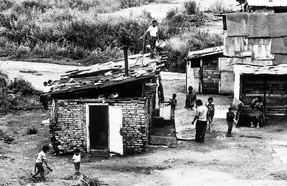
At a lecture (6th March) dedicated to ‘Futures’, we watched a footage of the destruction of Pruitt-Igoe. Originally, this estate was an attempt to house the inhabitants of St Luis, Missouri as a response to the post-WWII housing problem.
Pruitt-Igoe could be seen as ‘slums replaced by vertical ghettoes’. Having seen the footage, I could not help but to have a memory of Czech Roma brought to my attention. We always talk about ethics in design, usually naming designers as the ‘gods’ who could and should make a long- rather then short-term difference. When it comes to slums however, is it not also the politicians who become the designers? The ‘designers’ of peoples’ lives?
In the recent years, a problem of devastation of the town centre of Vsetin (a town in north-eastern part of The Czech Republic) was blamed on Romanies who lived in slum-condition houses nearby (they can actually thank themselves for this state). As a result, they were ‘removed’ to the suburbia of Vsetin to a housing system resembling Pruitt-Igoe of a better condition. Jiri Cunek, a mayor turned politician was responsible for this ‘removal’.
He became both popular with the public and infamous with the ethic minority in question. A recent program (5th March) on a BBC Radio 4 addressed this particular problem of Czech Romanies. It focused on one family that was rather ‘riotous’ about discrimination. ‘Not again’ was my response to this. Shortly after my thought, Jiri Cunek expressed my feeling. Roma people grab any opportunity of attention; foreign involvement is even better.
Of course there are people who have been forced to live in such conditions. Responding to Samuel Clarke’s blog and Mike Davis’s article entitled ‘Planet of Slums’, natural disasters or poor economic development of a country add to poor living conditions. It has also been suggested that the pressure of urbanization is turning rural areas into slums. In other words, the slum-like living conditions come to previously normal rural places. At this point, I bring back the economy and politics of a country.
Yet again, the politicians become the ‘designers’ of people’s lives. However, they are after all just the politicians. Therefore, in terms of design they can easily express themselves saying: ‘Should I weasel my way out of every decision?’1 (a design related that is). Hopefully not. They cannot rely on architects or product designers to solve all the problems. It is the country’s responsibility to ‘serve’ its people. Especially if a natural disaster strikes.
As for the Czech Roma mentioned above, no matter what the design. For centuries they travelled from place to place living a nomadic life and this is one of the reasons why it may be difficult to make them settle down in one place. They are used to travelling and visiting each other. As a result, a flat aimed to house a family of five will need to house fifteen and the destruction of a place is inevitable. This is a cultural rather than designer clash.
One has to live there to understand. There is no point to criticise a problem of one country if one has not actually lived there. Hence, BBC Radio 4 program on discrimination.
1 Fischli, P., Weiss, D. (2006), Will Happiness Find Me? (quotes translated by Catherine Schelbert), Koenig Books, London
Davis, M., (2006), Planet of Slums, Verso, London
Fischli, P., Weiss, D. (2006), Will Happiness Find Me? (quotes translated by
Catherine Schelbert), Koenig Books, London
BBC Radio 4 (5th March 2007)
http://en.wikipedia.org/wiki
http://romove.radio.cz/en/
Sunday, 11 March 2007
Widespread Panic Button

Reading Sebastian’s and Ana’s comments on the panic button has sparked a conflict regarding my own outlook on the ethical standpoint of mass media and information. Yes, fear can be a great tool for motivating large groups of people to become proactive with problems in the world; however, it is this same fear that can also lead to a nation’s complacency. One of the most discussed fear in media today, other then climate change, is terrorism. In the
This difference in reactions leads to an important question or notion that needs to be considered in the implementation of panic buttons; that is, what is the ethos of a nation regarding fear? How do someone’s cultural differences and set values affect their reaction to fear (i.e., do their imposed social practices matter when inducing a panicked response, like that of pressing a panic button). Designers are left with a general problem to solve in creating a universal panic button, and, how would one react to a device that would hinder or exacerbate his or her panic. When it comes to the symbolism of a panic button, the device represents something spasmodic, red, and initially cautionary; a device that causes alert or alternately even pacifies a nation (or person) in a time of chaos and is an object a designer has to take into consideration for its representation of a culture’s ethical stance. Only once this consideration is made can a designer truly create a device that is necessary. For example the doomsday clock moving minutes closer to midnight may have more of a powerful effect for Americans to become more aware of climate change, as it appears that most, not all (and even less now-a-days), Americans react to fear-based media more then other cultures.
Saturday, 10 March 2007
Natural and Artificial

Artificial is defined as formulation of something based on natural phenomenon but is completely lacks the intrinsic value of what is natural. Conservative thinkers postulate that incorporating artificial schema on environmental context is morally unjustified because it violates the natural mechanism of things, and in religious context, it defiles the God’s creation. Conversely, radical thinkers posit that the integration of artificial schema in the environment is morally permissible because it helps in the prolongation and preservation of life, especially that the world is facing a huge problems on natural resources continuous supplies.
Advocators of anti-artificial schema argue that the promotion of ersatz products necessitates the used of modern technology, and if certain technology is not yet available, then new technology must be invented first for the realisation of a specific artificial products. The problems with this is that most of the time, the actualisation artificial schema post threats on the natural resources because, one, a new technology must be applied to natural things before it can be proven, and if the technology fails, new technologies will be created, which means that the threat on environment will also increase; two, the artificial procedures of preserving life in the expense of our natural environment is becoming vicious because of the belief that preservation of life is justified in any given context, wherein our natural environment suffers greatly from this belief because the environment is only seen as resource that must be utilised for the nourishment of life.
On the other hand, proponents of artificial schema conjecture that natural resources is finite and limited, hence the need to manufacture ersatz products in the expense and out of natural resources is permissible because through this, the continually increasing demand for basic human needs will be resolved, as well as, the environment will be preserved. Radical thinkers argue that modern technologies may have repercussions but its benefits are countless. They even stress out that application of artificial schema with the aid of technology is the only way humanity can preserve its environment and its people.
Today the world is embracing the artificiality of things; foods products are being engineered, while natural environment are being photocopied such as lagoon, rainforest, etc. to prevent the continuous deterioration of the environment, and to preserve its present status.
Thus our modern advancements and artificial schemes have created major environmental positive consequences, as well as, risks that threaten the lives and well-being not only of ourselves but of the future generations and of other living creatures. For example, genetic engineering helps in the massive production of foods such as rice, vegetables, fruits, etc. albeit new diseases are being born and a great number of living creatures suffers because of the trial and error practice of such advancement. The point is, artificial schema may help in the preservation of life but the environment must suffered from it because once the natural mechanism of the environment is jeopardised, no one can alter its effect and no technology can fixed its problems.
Tuesday, 6 March 2007
“Push my panic buttons”
Why do I need to push a button to know or let others know I am panicking? How would pushing this panic button assist me in remaining calm and to act accordingly in a given situation? It is said that the external dangers meet the inner anxiety and are frequently experienced as even more dangerous than they really are. The outer anxiety expresses the ever-present dangers of the public world whereas the inner anxiety reflects the unresolved emotions.
Stress of modern day life, brought about through the advances of technology, pushes us beyond our tipping points. For example, before the 1990’s we weren’t so reliant on our mobile phones and nowadays we seem to store our whole lives into them, making the mobile an extension of ourselves, which leads to the consequences of losing them very dire. When I experienced losing my phone, I became an irrational frantic, immediately thinking the worst and prepared to do the worst at this desperate situation. I immediately found someone to blame, wrongly accusing them from taking my phone and ready to deal with the consequences. We sometimes worry so much about worst case scenarios that are unlikely to happen which impairs our judgement on the real danger that lies ahead.
Design is pushing our internal panic buttons. We seem to offload our contents into an object, which is designed to help us, but if this object fails us, it can cause us to panic. For instance, the computer was invented to store information and has now evolved to such an extent that allowed humans to become dependant on them. It is almost an extension of our brain. Thoughts written down, if lost, reiterating them would not only cause stress but your brain would be unable to write the exact same thoughts again. Losing this information through system error or viruses can cause panic and leads to frustration.
I do believe most panic buttons have their uses and have saved many lives but the practice of their usage needs to still be refined. Avoiding these potential dangers can come as a shock once confronted. Preparing us for the worst, it automatically makes us fear the worst, forcing us to act out of character and irrationally; becoming victims of frequent panic attacks. This is usually due to a build up of emotions, ‘safely’ locked in the back of our minds and the littlest input could trigger the panic button causing and outburst of emotions However, if a person feels fear constantly, there is no signal left for when it’s needed, thus, a person who chooses to worry all the time or persistently chew on unwarranted fears is actually making himself less safe. In a way, you become desensitised and you do not recognise the alarm as a sign of potential danger.
Further Reading- False Alarm, The truth about the epidemic of fear by Marc Siegel
the arts of survival

I think this subjects cool. In a past blog I moaned a little about panic buttons and how designers making objects and products in the event of an emergency can cause people to panic even more, this I guess is along the same lines in the respect that designers are developing “just in case items”. But a lot of these items are being designed for people that may have lost a home due to a natural disaster or those that are on the streets, so this is a subject that is clearly evident in today’s society and is something that is happening.
The transportable hobo homes that we saw in Jennifer’s last lesson I feel are a little bit of a lost cause, yes they serve a purpose, but what is stopping one homeless person stealing another homeless persons home, at least when they salvaged cardboard boxes they were recyclable, easy to dispose of and weren’t simply receiving a handout from the government.
Also I feel it is really important that emergency housing and shelter is built for the environment that the disaster is in, for example in brazil they make their shanty’s out of recycled items and anything they can use around them already in their environment to use as housing. Another excellent example of this site situation housing is Pallet-housing designed by Azin Valy and Suzan Wines for returning refugees in Kosovo. This consists of modular transitional housing constructed from pallets, “but how did those pallets get there?” I hear you ask. Due to aid delivering goods in areas of devastation, medicine, clothes and materials get delivered on such pallets enabling everything delivered being used to help the effort of housing those left homeless. The housing has a lifetime of around 5 years which is the time it would take for a family to rebuild their house out of stone.
The life expectancy is also very important on temporary housing not only to give the occupants an idea of how long they have until they have to re-build but to make them re-build, I know it’s a bit of a cheesy saying, “only help those that help themselves” but I consider it to be very important as there is a thin line between graciously taking someone’s help and taking the piss.

Another example of site specific housing if not temporary is container units. Merchandise gets shipped around the world in those massive containers you see being transported by trains, boats and lorries which means they already have the means to ship mass quantities of the stuff and they are cheap as they just clutter up ship yards and such. This is a method many designers have taken on and are using to make homes out of today, why cant they send these (already built houses) to devastated areas?
This is an interesting subject and is defiantly important, id like to have somewhere to live if some disaster happened in my area and left me homeless and the futures for this subject are challenging as we cant predict where it will happen and on what scale, leaving a lot of room for a designer to solve a pressing issue and have fun.
Vicious circle
When researching the solutions humans have in combating global warming I was amazed to discover how ridiculous some of the proposals seem to be, and not only that but they don’t seem to be doing what is actually necessary.
It seems that most have accepted that we are heading for disaster and, rather than looking for ways to change our ways, we are coming up with solutions to put into effect just at that crucial point before the disaster happens. The understanding that this point is definitely going to happen seems depressing in itself, but more so the solutions that our so called intelligent scientists have come up with. It is not to say that I could come up with anything better but spending so much effort in finding a solution rather than combating the initial problem seems ridiculous.
It has been human technology that is the cause of most of the earths problems, so it is no surprise that the way in which we have decided to tackle the issue if the worst comes to the worst is through technology also. One of the most ‘interesting’ solutions proposed my Roger Angel of the University of Arizona includes putting a fleet of small spacecraft into the atmosphere. Trillions of these objects will form a cloud in which to reflect 2% of the suns light and therefore cooling the earth. Other proposals have been to put a reflective layer over the deserts or filling the seas with plants to suck in all the CO2. I find these solutions fascinating, especially when they are apparently technically possible, although I am still sceptical and am sure there must be a more natural way.
It seems there is a vicious circle, humans have decided they wont change their modern lifestyle and so are combating their already destructive effect on nature with yet more unnatural intervention to solve it. There are of course more natural and sustainable efforts being made but it seems sad that our final stand to save our environment will be yet more technological intervention.
Panic Buttons

‘As more of our sense of what threaten us comes from the news and media and internet, we lose track of our former guides…bright lights of computer screens and TV screens that offer info fragments, alarming us more often then they reassure.’ (Marc MD Siegel, 2006)
No news is good news they say, but as we all know too well bad news sells. The media can impact us in a positive or negative way, it enlightens us but it is also the bearer of bad news.
Before the turn of the millennium the media coverage on the threats of the Y2K bug caused public panic all across the Western world. Government guidelines where issued to prepare the public for the worst, adding to the growth of hysteria. It was predicted that the bug would cause computers systems to crash, creating chaos like a scene out of the film 28 days later, as our basic needs such as water, food and electricity would be affected. Consequently the worried public rushed to supermarkets stocking up on essentials such as water, food and gas, just in case the world did cease operating at midnight. However Y2K never happened and all returned to normality.
Our choice to engage with the news and mass panic may be a reflection of ourselves, bad news taps into an innate, primitive part of us that enjoys the thrill of fear, like an adrenaline junkie to his extreme sport. Scary stories and tales of the unknown captivated our ancestors and served a purpose to these communities who tried to understand their surroundings, warning each other of the possible dangers that nature holds.
Therefore I do not agree with Sebastian that we need to avoid the media, choosing to live a life of ignorance can be bliss and it may resolve modern day afflictions such stress, phobias and panic attacks. However a little bit of fear and panic can be a great tool for survival in the outside world, keeping designers and manufactures of panic buttons busy.
Further reading:
False Alarms, The Truth about the Epidemic of Fear by Marc M.D Siegel
Culture of Fear by Frank Furedi
PANIC BUTTON
I think I need the panic button. I am going shopping; or perhaps I should say I may be causing an ecological disaster. First, don’t let me forget my ecological cotton shopping bag; the consequence of using plastic shopping bags is too dire to contemplate. We know a lot of plastic waste material is shipped to China where poor low paid workers will flake the plastic using their bare hands and teeth, if they survive this they may run the risk of cancer from the toxic fumes caused by incinerating the plastic. Then this lethal concoction will be shipped back in the form of pellets to make more plastic bags.
I daren’t use my car otherwise I will increase the carbon emissions in the already polluted atmosphere .so I walk. Once inside this Aladdin’s cave of potential disaster what do I do? Meat; no better not. I can’t have beef; I might become a mad cow. Chicken or turkey served with bird ‘flu sauce. Pass. How about some pork so I can increase my cholesterol become obese and then be refused a by-pass operation on the National Health on the grounds that it is my own fault. How about fish, tuna perhaps? No, the nets used to fish them could have trapped and killed dolphins. Better move on to the fruit and vegetables. It is all pre-packed in polystyrene trays, which release CFC into the atmosphere when they are destroyed. And what pesticides have been used? I don’t want to buy GM food. Perhaps I’ll just go to my local greengrocer’s where the produce is sold lose and only local goods are sold.
Cleaning fluids are just out of the question, just a bit of vinegar to clean with and leave the lavatory dirty.
So I’ll go for beans and lentils then the cows won’t be the only ones releasing toxic gases into the environment. No biscuits or packed cake or crisps as the packs will go into the already overflowing landfills.
Shall I venture into the clothes and sports section? Will I be tempted to buy cheap Chinese sports shoes or equipment made using child labour? No, better not. I need some comfort food, let me buy some chocolate, oh no it is Nestles! Get me out of here get me a panic button.
Sunday, 4 March 2007
The arts of survival
The arts of survival
‘The slum is the measure of civilization’
Jacob Riis
Through trying to understand the severity of ‘slum environments’ we are able to begin to have an ethical stance on the topic of slums.
If western society is able to look from a distance at what has been created or allowed to develop in mega cities, such as Sao Paulo, maybe a twinge of guilt will be felt by western culture. At present it seems that western society has cast responsibility of the existence of the shanty towns on the dwellers that live there. Whereas, Jacob Riis suggests that western culture needs to take the blame for the severe standard of living that is taking place. For, as an ethical society, we should know better than to accept that this type of living exists.
Riis makes an interesting point about ethics which is that shanty towns are a reflection on our ethics and the choices we make as human beings. If we are able to accept and not feel guilt for fellow human beings that live in the mentioned conditions what does that say about our ethics?
How do we get out of this situation?
In the supporting lecture it was questioned whether design is able to help overcome the slum situation. I see the situation as a larger scale issue than design. Problems with less economically developed countries (LEDC’s ) go far beyond town/city planning. LEDC’s economic survival is crucial to whether these particular regions will be able to move out of the slum environment.
This topic is larger than a righteous designer saying how ‘devastating’ the situation is and how they as a designer are going to make a difference. I know this appears a pessimistic view. However, the outlook looks bleak on the subject. This is the difficulty in dealing with a topic as severe as ‘slum environments.’ It is all too easy to say ‘this out of my hands’ as it is also to say ‘make the world a better place’ but that is not to say, let us sit back and do nothing. I may not know of solutions but I know that the current situation is not acceptable to live with.
It was suggested, as Olivier Ward writes, that people began to argue positively for favelas in the class seminar, arguing that there was ‘enjoyment’ in living in such a place or that it would be ‘ok’ because ‘mother earth’ will sort out the situation. I do not believe that either of these suggestions made, were thought about in an ethical manner but it does go to show the extent to which people begin to try and detach themselves from the situation and also end up at ridiculous solutions to the problem.
I know of no answer to solve the problem of slums. It is possible when we look at solving the problem we are actually taking on the entire subject of developing less economically developed countries rather than the one particular aspect of slums. I have not come to any grand conclusion apart from that this is an issue that people need to become ethically engaged with in order for the slum environment to ever be overcome.
Planet of Slums by Mike Davis.
Self interest is why we should help, and why people will. Olivier Ward
Packard, Vance. The Waste Makers (London: Mckay, 1960).Papanek, Victor J. Design for the Real World: human ecology and social change (London: Thames and Hudson, 1995).Hawkins, Gay. Plastic Bags: Living with rubbish (London: Sage, 2001)
Thursday, 1 March 2007
Self interest is why we should help, and why people will.
To continue the class discussion, and further debate why should we help slum dwellers and improve living conditions in slums.
In his book Planet of Slums, Mike Davis proposes that slums are one of the roots of terrorism, and that the scale of economic exclusion that occurs when slums are formed will inevitably lead into violence, drug taking and smuggling, as well as other forms of illegal activities. I for one cannot accept that slums are the only cause of these issues nor that by getting rid of Favelas we will win this so call “war” on terrorism. After all Osama Bin Laden didn’t grow up in a slum, nor was his family poor (on the contrary). However I can believe that slums provide a more productive breeding ground for those who want to recruit and train people to join extremist causes, or simply into drug trafficking or prostitution.
To follow the line of thought that was voiced on Tuesday that these illegal activities are a cause of slums, and that we should accept it as a natural consequence until “mother earth” sorts it out with some sort of mud slide or perhaps even bubonic plague is highly dangerous. It would be like saying, let the heroin addicts do there thing, I’m sure HIV will wipe them out eventually. Furthermore to suggest that we should spend the money on relief funds for when the terrorist attack/ armed robbery/ drug trafficking/ prostitution ring reveals its ugly outcome is naïve. This would clearly be a false economy, as the price of dealing with these outcomes will inevitably rise as the slums continue to grow. Far cheaper would it be in the long run to attempt to find a solution to the causes.
It is easy to get carried away in this line of thought and start believing that all slum dwellers are prone to becoming involved in illegal activities, that all slum dwellers live in total squalor, surrounded by pollution, excrement and decay- and this is simply not true. There are many people who live in shantytowns who work in the public sector, and are reasonably happy with their situation. However this is further reason why we should help improve infrastructure, sanitation, schooling etc…
I will concede that by continuously offering to “improve” slums the international community (donor countries, NGOs and multilateral agencies) run the risk of wanting (and trying) to impose a way of life, aspirations and rules of social behaviour on people, that are inappropriate, unwanted and maybe not needed. This should be avoided at all costs and it is exactly this criticism that has been raised against the World Bank institutions, international donors and NGOs in relation to many of the grand scale ideas and projects that have been promoted and financed over the years. It is not up to the “international community” (whoever they may be) to impose a way of life on people; it is up to those people to create one for themselves. I see the giving of a Noble prize to the founder of the movement for “micro-finance” and the growth of and support given to this form of very basic financing for individuals and communities who are otherwise cut off from the capital they need to self-improve as a sign that there is a recognition that we need to do things differently.
I recognise the moral obligation to at least attempt to ensure that no person should have to go without basic amenities (such as clean water and sewerage) or live and sleep in total squalor under the fear that things could get a lot worse tomorrow. If by doing this and improving the worst slums, we by result help reduce crime, terrorism and other forms of extremist antisocial behaviour, then that should be supported and encouraged. The moral obligation then becomes a matter of self-interest and self-interest usually motivates people more than their morals.
Wednesday, 28 February 2007
Massive Change; A New Type Of Design.

“The twentieth century will be chiefly remembered by future generations not as an era of political conflicts or technical inventions, but as an age which human society dared to think of the welfare of the whole human race as a practical objective.” (Arnold J. Toynbee, 1889-1975).
It was clear in Tuesday’s lecture that this was not a notion shared by most. Personally, I believe that design is everywhere; it can concern anyone and anything. Most of the individuals referenced below do not consider themselves as designers, but they speak of “designing systems, designing organisations, designing organisms, designing programs. We must admire and participate in the efforts of these thought-leaders or risk losing them.”
“Most of the time we live our lives within invisible systems, blissfully unaware of the artificial life, the intensely designed infrastructures that support them.”
“Accidents, disasters, crises. When systems fail we become temporarily conscious of the extraordinary force and power of design, and the effects that it generates. Every accident provides a brief moment of awareness of real life, what is actually happening, and our dependence on the underlying systems of design.”
In considering alternative housing for slum-dwellers, Katy suggested the need for affordable design that is also appealing. Carol Burns of Taylor and Burns Architects also maintains a similar position and argues that “it’s true that manufactured housing too often has looked cheap and has been stigmatized in various locations because of it. But I believe that good design need not cost more than poor or inattentive design.”
Currently, a solution to the ‘slum problem’ seems impossible, especially when the Third World consists of “entrepreneurs who struggle to build informal urban environment by hand. What if we were to design a property system that supports this?” Individuals such as Hernando de Soto, a Peruvian economist who redesigns property law to grant property rights to the poor, show that problems like these can be solved.
It has become a common misconception that “if people have a roof, they have shelter.” De Soto argues that “people need more than a roof. You need that roof in the system.” Olivier mentioned a project in Shanghai that aimed to eliminate slums. Unfortunately, the solution considered the province of Shanghai in separatist terms; the system should have been implemented throughout the whole country to create a full effect, and not just in one provincial area. Instead of “isolated parcels of land…it’s now a matter of considering an entire city infrastructure and its connected environs.” Architects tend to build pieces of city without regarding their relationship to the whole. Perhaps change is required in the design practice and in the thinking (of designers) before global change itself can be realised?
As far as the issue of money is concerned, “we now bare witness to an emergence of social entrepreneurs with ethics as powerful as their conviction to do the greatest good for all.” In 1999, Slovakia saw an increase from 10 to over 10,200 citizen groups in 10 years, whilst Brazil increased its citizen groups from under 5,000 to over 1,000,000. There are many citizen groups, nongovernmental organisations and non-profit associations (such as Bill Drayton’s Ashoka) that share the same goal.
Poverty reduction through design rejects the binary notion of the client/designer relationship, and observes current events. Problems are adopted everywhere, whilst ideas are developed and tested against other solutions. The effect of this is “to imagine a future for design that is both more modest and more ambitious. It is critical that the discussions go beyond the design fields themselves and reach out to the broadest audience” i.e. to those directly affected by the work of designers. Only then can we bring about Massive Change.
References and Further Reading:
- Massive Change by Bruce Mau and the Institute Without Boundaries, especially the Urban Economies and Wealth & Politics chapters.
- Taylor and Burns Architects, Carol Burns.
- The Institute for Liberty and Democracy (Lima, Peru), Hernando de Soto.
- Ashoka, Bill Drayton.
- It's Not How Good You Are, It's How Good You Want To Be by Paul Arden.
- Planet of Slums by Mike Davis.
Tuesday, 27 February 2007
Change one thing!

As you may know, with the powers of persuasion and regulation the Aussie Government have recently introduced a ban on incandescent light bulbs, persuading the public to switch to fluorescent bulbs which use less energy and omit less green house gases. In incandescent light bulbs, electricity flows through a filament to create light, but much of the energy is wasted in the form of heat.
Australian Prime Minister, John Howard’s approach is to unite Australia in this potentially huge global change to the environment, this seems like an obvious route to take, but its a first to create a ban on light bulbs, something seemingly so trivial.
Howard’s been quoted as saying “Here’s something practical that everybody will participate in”
This statement enforces a feeling of ‘follow the leader’.
When it comes to making a change in the environment, it has usually taken a minority of environmentalists to test the water to induce a change.
But it now seems a ‘trend’ for being eco-friendly has been born! No longer is it a stereotyped job for ‘hippies’ to fight for change on behalf of the environment, now the average Joe can join in, and be respected for his contributions too!
Many of us Brits have already jumped on the ‘eco- friendly’ band wagon, but the English “I don’t care, I won’t be around when that happens” approach still feels like we have too much choice, there should be more pressure from our government, to crack down on this climate problem.
And could we feel more climate-self-assured if Tony Blair followed in Howard’s footsteps? Blair has swapped his light bulb above No.10 to a florescent one! Surely he can promote the importance of changing to florescent bulbs nationally, by contributing to the incandescent bulb ban.
However, Australia still refuses to sign the Kyoto protocol; an agreement made under the United Nations Framework Convention of Climate Change (UNFCCC)
The Kyoto Protocol covers more than 160 countries globally, including the UK.
Isn’t it rather embarrassing that a country as un-green as Australia is showing up Britain?
It is said that Australia’s switch to fluorescent bulbs could prevent 4 million tons of carbon emissions being pumped into the atmosphere, and would cut household power bills by 66%, by 2012.
If this turned into a global fashion 16 Billion tons of gases would also be prevented from harming our environment.
Cuba had launched the same scheme, two years ago, but more so to prevent electrical blackouts around the island. California is now considering a similar ban on the light bulbs, hopefully the remaining states of America could consider this too!
By changing this one simple element in the household has Australia created an international panic button?
And although florescent bulbs are slightly more expensive than standard bulbs, it seems a small price to pay on our part! Change your light bulb and help save the world!!
www.msnbc.msn.com
The Guardian
The Guardian
Subscribe to:
Posts (Atom)